 Skip to main content


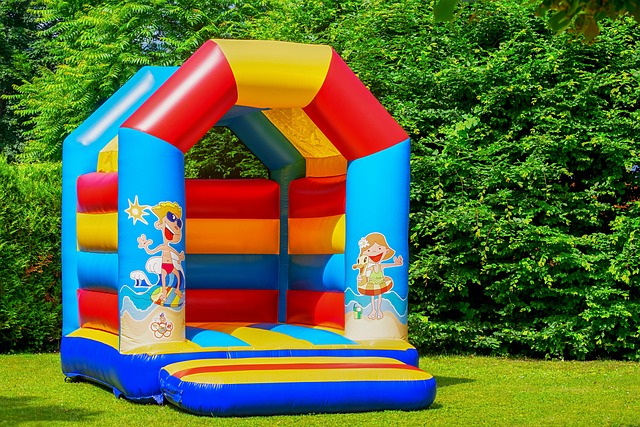
Starting an inflatable bouncy house rental business turns birthday parties, school fairs, and corporate picnics into repeat, weekend-driven revenue — but only if the equipment, insurance, and pricing are right from day one. This guide is written specifically for the inflatables niche of party rental, not party rental in general: bounce houses, slides, obstacle courses, and combo units carry their own safety certification, insurance profile, and seasonal demand curve that a generic «how to start a rental business» article won’t cover. Below is what it actually costs to get started, which safety standards you’re expected to meet, and the mistakes that put first-year operators out of business.
What sets a bounce house rental business apart from general party rental
An inflatable rental business rents bounce houses, inflatable slides, obstacle courses, and combo units — a narrower category than general party rental, which also covers tables, chairs, tents, linens, and catering equipment. The narrower focus is an advantage for a new operator: inflatables have a lower per-unit cost of entry than tents or full event catalogs, and demand is driven by a predictable calendar of birthdays, school events, and community festivals rather than by winning corporate event contracts.
If you’re weighing inflatables against the wider category before committing, our guides on how to start a party rental business and how to start an event rental business cover the broader catalog and higher-touch sales process those businesses require.
Is an inflatable rental business profitable?
An inflatable rental business can reach profitability within one to two seasons if you keep weekend utilization high and control the two biggest recurring costs: equipment replacement and insurance. Revenue is concentrated in a handful of high-demand weekends per month, which means a single unit sitting idle mid-week doesn’t hurt margin the way it would in a business with flatter demand.
The two levers that move profitability fastest are add-on revenue (delivery fees, generator rental, attendant staffing) and utilization (how many weekends a unit books versus sits in the warehouse) — not headline rental price. Before locking in inflatables specifically, it’s worth sanity-checking demand and competition in your area against our broader guide on how to choose the right rental niche.
How much does it cost to start a bounce house rental business?
Startup costs for an inflatable rental business break into three buckets: equipment (commercial-grade units, blowers, extension cords, repair kits, safety mats, and a trailer or van to transport them), compliance (business registration, a tax/VAT ID, permits, and insurance), and operations (a website, online booking, and payment processing). Equipment is the largest line item, and it’s also the one entrepreneurs most often underestimate, because backyard-grade inflatables look identical to commercial-grade ones in a product photo but fail commercial insurance underwriting and safety inspection.
Before finalizing a number, put it in writing: our guide to creating a rental business plan walks through how to structure a startup budget that a lender or insurer will actually accept.
Buying new, buying used, or starting small: comparing your equipment options
There’s no single right way to build your first fleet — the right approach depends on how much capital you have and how confident you already are in local demand. Starting with 3–5 versatile combo units almost always beats starting with one large, expensive unit, because it lets you serve more bookings per weekend and diversify against a single unit going down for repair.
| Approach | Upfront investment | Risk level | Best for |
|---|---|---|---|
| Buy new, commercial-grade | High | Low — full warranty, passes insurance underwriting immediately | Operators with validated local demand and financing in place |
| Buy used from a closing operator | Medium | Medium — inspect vinyl, seams, and blower hours before buying; re-certification may be needed | Operators who want to test the market before committing full capital |
| Start with one combo unit + expand | Low | Low–medium — limited weekend capacity caps early revenue | First-time owners validating demand in a new territory |
| Lease/finance a starter fleet | Low upfront, ongoing payments | Medium — financing costs erode thin early margins | Operators prioritizing cash flow over long-term unit ownership |
Licenses, insurance, and safety standards you actually need
This section is informational, not legal or compliance advice — business registration, permitting, and inspection requirements vary by country, region, and municipality, so confirm current rules with your local licensing authority and insurer before you launch.
Registering the business is usually the easy part: choose a business structure, register the name with the relevant authority in your country, and get whatever tax or VAT identification number your jurisdiction requires (for example, an EIN in the US, or a VAT registration in most EU countries). The part new operators underestimate is insurance and safety compliance, because inflatables carry a higher injury-liability profile than most other party rental categories, and the specific rules here do vary more by country than the business-registration steps do.
Commercial inflatables are generally expected to meet a recognized regional safety standard covering design, manufacture, operation, and maintenance — ASTM F2374 in the US, or EN 14960 in the EU and UK. Ask any manufacturer for compliance documentation against whichever standard applies in your market before you buy; a unit built for one region doesn’t automatically satisfy the other’s requirements. Many regions also expect or recommend periodic third-party inspection — NAARSO certification is a common reference point in the US, and schemes like PIPA tagging serve a similar role in the UK — check what your local insurer recognizes. On the insurance side, a general liability policy sized for bodily-injury claims — not a generic small-business policy sized for property damage — is the baseline everywhere, even though minimum coverage amounts and terminology differ by country; our rental business insurance guide breaks down coverage types in more depth.
Choosing commercial-grade inflatables that hold up
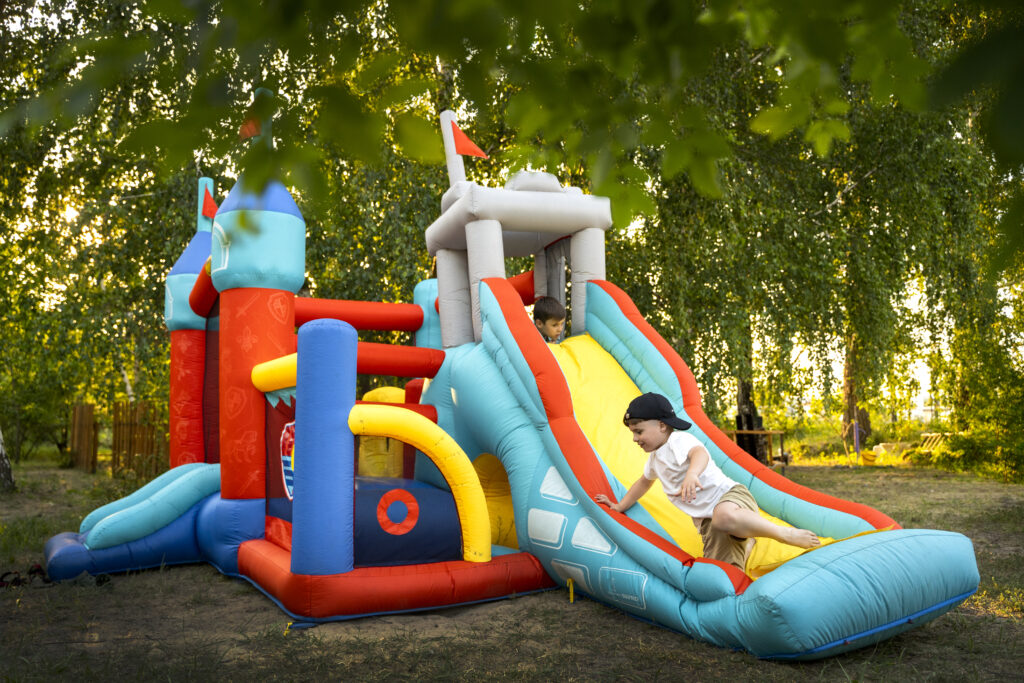
Commercial-grade inflatables are built for daily setup, teardown, and transport — residential-grade units are not, even when they look similar in a catalog photo. Evaluate vinyl weight and stitching quality, blower duty-cycle rating, and whether the manufacturer supplies compliance documentation against the standard that applies in your market (ASTM F2374 in the US, EN 14960 in the EU/UK) up front, before price.
Diversifying across combo units, obstacle courses, and water slides broadens the events you can serve, from birthday parties to school field days. Once your fleet grows past a handful of units, tracking which unit is booked, delivered, cleaned, and due for inspection by spreadsheet stops scaling — inflatable and bounce house rental software is built specifically for that fleet-and-booking overlap.
Setting rental rates and managing bookings
Price inflatables by the day, not the hour — most customers book a bounce house for an entire party window, and hourly pricing creates scheduling friction without capturing more revenue. Rates typically scale with unit size and features (a standard bounce house costs less than a combo unit with a slide), and delivery distance, setup complexity, and weekend demand all justify a premium over a flat base rate.
Our guide on pricing strategies for event rental businesses covers the cost-based and market-based pricing models in more detail. Whatever pricing model you choose, online booking with real-time availability prevents the double-booking errors that are especially costly on inflatables, where a no-show delivery can mean a ruined birthday party and a public review.
Marketing your inflatable rental business
A professional website with real photos of your actual units, local SEO for «bounce house rental [your city],» and a Google Business Profile drive most of the organic bookings in this category — most parents search locally and book within days of their event, not weeks in advance. Partnerships with local party planners, schools, and children’s venues extend reach beyond search.
Our marketing strategy guide for rental businesses covers the local-SEO and Google Business Profile setup step by step.
Common pitfalls in the bounce house rental business
- Skipping annual re-inspection — Vinyl, seams, and blowers wear faster than owners expect under daily setup/teardown. Schedule a NAARSO-recognized inspection annually and keep dated records; insurers may ask for them after a claim.
- Insuring for property damage but not injury claims — A generic small-business policy often excludes the bodily-injury scenarios inflatables are most exposed to. Buy from an insurer that specifically underwrites amusement/inflatable rentals.
- No written weather policy — Manufacturers generally advise against operating inflatables above roughly 20–25 mph (32–40 km/h) sustained wind. Without a written cancellation/reschedule policy in the contract, operators either eat the refund or take the safety risk of running anyway.
- Overbuying inventory before validating demand — A single large combo unit ties up capital that three versatile mid-size units would put to better use across more weekends.
- Not verifying the delivery site in advance — Uneven ground, overhead power lines, or no accessible power outlet are the most common on-site failures. A required site-photo or address check at booking time catches most of these before the delivery truck arrives.