Skip to main content



A customer stands at your counter — or, increasingly, sits at home on their phone — ready to book a car, a cabin, a crane, or a camera kit. The pricing is agreed, the dates are set. Then the process stalls on the one step that hasn’t caught up with everything else: the signature.
For rental businesses, the agreement is the transaction. Every booking depends on a signed rental contract, a damage waiver, or a deposit terms sheet, and every hour spent printing, scanning, or chasing a signature is an hour a unit sits unbooked. Electronic signatures close that gap. Used correctly, they make agreements faster to complete, easier to store, and — under the right legal framework — just as binding as a signature written in ink.
This guide walks through what an e-signature actually is, the law that makes it enforceable, and how rental businesses can put it to work across bookings, rental agreements, and check-in/check-out workflows.
What is an e-signature, really?
An electronic signature is any electronic sound, symbol, or process attached to — or logically associated with — a document, and executed by a person with the clear intent to sign it. That’s a deliberately broad definition. Typing your name into a text field, drawing a signature with a finger on a tablet, or clicking “I Agree” on a rental checkout page can all qualify, provided the intent to sign is genuine and recorded.
That breadth is also why not all e-signatures carry the same weight. Regulators distinguish between tiers of assurance:
| Signature type | What it requires | Typical rental use case |
|---|---|---|
| Simple electronic signature | Typed name, click-to-accept, or a drawn signature; minimal identity verification | Standard rental terms, low-value bookings, damage waivers |
| Advanced electronic signature (AES) | Unique signer identification and tamper-evident sealing of the document | Multi-day equipment or vehicle rentals, deposits, liability-heavy agreements |
| Qualified electronic signature (QES) | A qualified signature-creation device plus a certified digital ID (e.g., under eIDAS in the EU) | High-value fleet contracts, cross-border B2B rental agreements |
The step up from “simple” to “advanced” usually comes down to identity verification. This is why many rental platforms pair e-signatures with an ID-verification layer — Sharefox customers, for example, can combine contract signing with BankID identity verification for a signature that’s both convenient and strongly authenticated.
Digital signature vs. electronic signature
The two terms get used interchangeably, but they’re not the same thing. “Electronic signature” is the broad legal category described above. A “digital signature” is a specific technical method — one that uses public key infrastructure (PKI) and a digital certificate to cryptographically bind a signature to a document. A digital signature is always a form of electronic signature; not every electronic signature is a digital signature.
Is an e-signature legally binding? The rules that matter
In the United States, two laws do most of the work:
- The ESIGN Act establishes that an electronic signature carries the same legal weight as a handwritten one, and that a contract “may not be denied legal effect… solely because it is in electronic form.”
- UETA (the Uniform Electronic Transactions Act), adopted by nearly every U.S. state, provides the state-level framework that makes electronic records and signatures enforceable in day-to-day transactions — including rental agreements.
“A signature, contract, or other record relating to such transaction may not be denied legal effect, validity, or enforceability solely because it is in electronic form.” — ESIGN Act (U.S. federal law)
In the European Union, the equivalent framework is eIDAS (electronic identification, authentication, and trust services), which formally defines simple, advanced, and qualified electronic signatures and sets out when each is recognized across member states.
None of these laws make every e-signature automatically enforceable, though. To hold up, an agreement generally needs:
- Clear intent to sign — demonstrated through an explicit action like clicking “I Agree” or drawing a signature.
- A verifiable link between the signature and the specific document signed.
- Record integrity — evidence the document wasn’t altered after signing.
- Signer access to a copy of the signed record for future reference.
Advanced and qualified signatures build on this baseline with a digital certificate and a full audit trail, which is why higher-value rental agreements — long-term equipment leases, vehicle fleet contracts — often use them by default.
What e-signatures change for a rental business
Faster turnaround, fewer bottlenecks
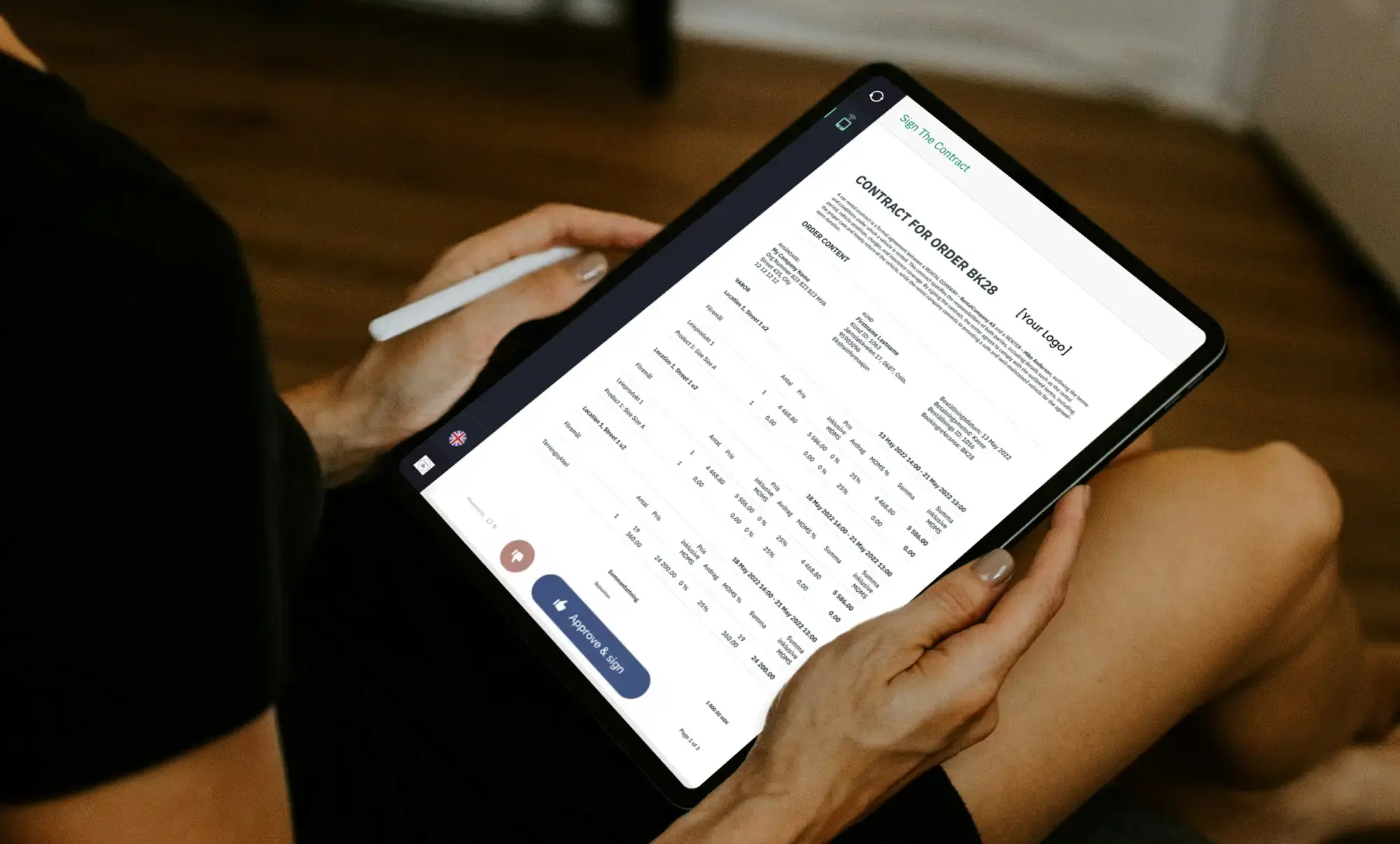
Removing the print-sign-scan cycle from a rental workflow has a direct effect on booking speed. A customer can review and sign a rental agreement from their phone before they’ve even arrived to pick up the equipment, which is exactly the kind of frictionless step that rental booking software is built to support. The result is shorter time-to-booking and less staff time spent handling paperwork instead of customers.
| Paper-based signing | E-signature workflow | |
|---|---|---|
| Time to complete a signed agreement | Hours to days (print, sign, scan, file) | Minutes, from any device |
| Storage & retrieval | Physical filing, prone to loss or damage | Centrally stored, searchable, backed up |
| Audit trail | Manual, easy to dispute | Automatic timestamp + IP/device log |
| Customer experience | On-site only, requires a physical visit | Remote-friendly, works from a phone |
| Error risk | Missing pages, illegible signatures | Required-field validation before signing |
A stronger security and evidence trail
Advanced electronic signatures pair a digital certificate with encryption to confirm both the signer’s identity and that the document hasn’t been altered since signing. That combination produces an audit trail that’s considerably harder to dispute than a photocopied signature page — useful if a damage claim or a deposit dispute ever goes to a small-claims hearing.
A better customer experience, end to end
For the renter, the benefit is simple: no printer, no scanner, no trip to a counter just to sign paperwork. They can review terms and sign from a phone before pickup, which fits naturally into a self-service rental model where check-in doesn’t require staff to be present at all.

Putting e-signatures to work in your rental workflow
Choose a solution built for compliance. Look for a platform that’s explicit about ESIGN, UETA, and, where relevant, eIDAS compliance — not just a generic form builder. Integration options matter too: Sharefox’s contract-signing integration with Criipto, for instance, is designed specifically to bring compliant e-signatures into the rental booking flow rather than bolting them on afterward.
Map every document that currently requires a wet signature. Rental agreements, damage waivers, deposit terms, move-in/move-out checklists — each of these is a candidate for automation. Start with your highest-volume document (usually the core rental agreement) and expand from there. A free rental agreement template is a useful starting point if you’re formalizing your contract for the first time.
Connect signing to the rest of the booking flow. E-signatures work best when they’re one step in an automated sequence — booking, ID verification, prepayment, and signature — rather than a separate errand. Platforms with built-in integrations can chain these steps together without manual handoffs.
Train your team and set expectations with customers. Staff need to understand why the process is legally sound, not just how to click through it, so they can answer questions confidently. A short, plain-language note to customers about how signing works — and that it’s just as binding as a signature on paper — removes hesitation at the point of booking.
If you’re evaluating rental software with contract handling built in, it’s worth reviewing an all-in-one rental management platform rather than stitching together separate booking and signing tools — or booking a demo to see how the pieces fit together for your specific rental category.

 All in one platform