Skip to main content



Pricing is the single lever that most directly moves a rental company’s bottom line. Get it wrong, and utilization stalls or margins quietly leak away. Get it right, and the same fleet, the same storage units, or the same equipment yard can generate meaningfully more revenue without adding a single new asset. That is the promise of a modern pricing engine — and it’s why Sharefox built one directly into its all-in-one rental commerce platform.
This guide explains what a pricing engine actually does, how dynamic pricing works inside Sharefox, and how rental, mobility, and self-storage operators are using it in practice. Where relevant, we’ve linked out to independent research so you can verify the market data yourself, and linked internally to the specific Sharefox pages and guides that go deeper on each topic.
Understanding the Pricing Engine
What Is a Pricing Engine?
A pricing engine is the software layer that automates how a business sets, adjusts, and applies prices across its catalog. For a rental commerce platform like Sharefox — built to help operators run and scale equipment and vehicle rental businesses — a pricing engine isn’t a “nice to have” add-on. It’s core infrastructure. It ensures prices stay accurate and consistent across every B2C and B2B touchpoint, from a self-service online checkout to a negotiated corporate contract, and it’s a foundational requirement of any serious rental management system.
Components of a Dynamic Pricing Engine
Sharefox’s dynamic pricing engine draws on several connected modules to calculate prices in real time:
- Rate rules and rate cards — base prices, minimum rental periods, and tiered discounts
- Availability and demand signals — how utilization for a given asset is trending
- Customer and channel context — B2C vs. B2B, self-service vs. sales-assisted
- Duration and model logic — short-term, long-term, and subscription-based rentals
Together, these modules let one system support hybrid pricing models — combining subscription, short-term, and long-term rentals alongside sales and service bookings — without operators having to juggle spreadsheets or manually override rates.
Inside Sharefox’s Advanced Pricing Settings
Rather than describe this in the abstract, here’s what it looks like in the Sharefox admin panel itself:
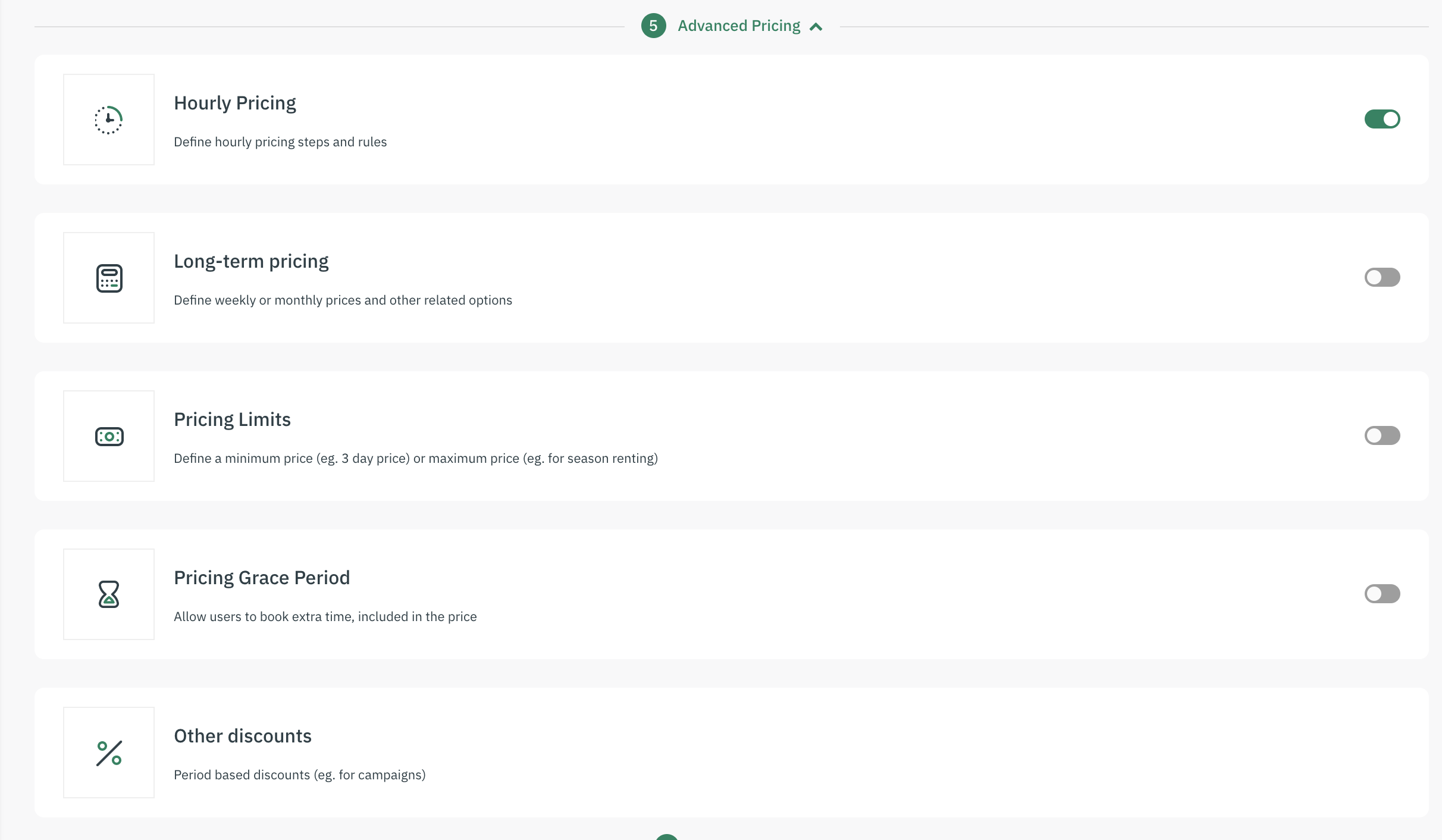
Each toggle controls a distinct piece of the pricing logic, and operators can switch them on independently depending on what their business needs:
- Hourly Pricing — define hourly pricing steps and rules, useful for short-notice or same-day rentals
- Long-term pricing — set weekly or monthly rates and related options, for subscription-style or extended rentals
- Pricing Limits — set a minimum price (e.g., a 3-day floor) or a maximum price (e.g., for peak-season renting), so automation never prices an asset outside acceptable bounds
- Pricing Grace Period — let customers book a small amount of extra time included in the price, reducing friction and late-return disputes
- Other discounts — apply period-based discounts, such as campaign pricing
This is what “advanced pricing configuration” means in practice — not a single dial, but a set of independent rules that combine to produce the final price a customer sees.
How Real-Time Pricing Works
Real-time pricing draws on automation across the platform to make pricing decisions the moment a booking is initiated, factoring in current demand, availability, and the rules an operator has configured. According to research from McKinsey & Company on the shift toward usage-based and subscription models, flexible, demand-responsive pricing is becoming a baseline expectation among B2C customers rather than a differentiator — which is exactly the gap a real-time pricing engine is built to close. For rental operators, this typically translates into three outcomes: less manual administration, higher utilization, and stronger revenue per asset.
Dynamic Pricing Strategies
Benefits of Using a Dynamic Pricing Strategy
A dynamic pricing strategy lets a rental business respond to market demand without adding headcount. Because booking, inventory, and invoicing run through one integrated system, the potential for manual error drops sharply, and self-service booking becomes viable at scale. Two examples from the Sharefox customer base illustrate the point:
- Mobility managers use digital check-in/out tools to automate the handover process, boosting turnaround speed and cutting idle time — a workflow covered in detail in our guide on self-service and keyless car rental.
- Self-storage managers offer online booking and payment for units, automate access control, and expand into new sites with minimal added administrative load — see our breakdown of self-storage automation.
Identifying Pricing Opportunities in Real Time
Sharefox’s pricing configuration and analytics surface pricing opportunities as they emerge, rather than after the fact. Mobility managers use these signals to increase turnaround speed and reduce idle time; self-storage managers use them to protect recurring revenue by automating access, billing, and communication for subscriptions and long-term agreements. Our post on effective pricing strategies for rental businesses walks through the specific signals worth watching.
Automation in Dynamic Pricing
“Pricing is no longer a static decision made once a quarter — for asset-heavy businesses, it’s a continuous calculation that has to account for utilization, seasonality, and customer segment simultaneously.” — Industry perspective, paraphrased from equipment and fleet rental market commentary. Verify against the original source before citing externally.
Automation is what makes that continuous recalculation possible without a dedicated pricing team. Mobility managers use it to fully automate check-in/out for a smoother customer experience; self-storage managers use it to streamline access, billing, and communication end-to-end. Our guide on equipment rental pricing strategy has more detail on how to set the underlying rules automation runs against.
Static vs. Dynamic Pricing: A Quick Comparison
| Static Pricing | Dynamic Pricing Engine (Sharefox) | |
|---|---|---|
| Rate updates | Manual, periodic (e.g., quarterly) | Automated, real-time |
| Demand responsiveness | Low — same rate regardless of demand | High — adjusts to utilization and availability |
| B2B vs. B2C handling | Usually separate systems or manual quoting | Unified rules engine across both channels |
| Admin overhead | High — manual rate sheet management | Low — rules run automatically |
| Risk of human error | Higher | Lower |
| Support for hybrid models (subscription + short/long-term) | Difficult to manage manually | Native support |
| Revenue per asset | Tends to plateau | Trends upward as utilization improves |
Implementing a Real-Time Pricing Engine
Using a Pricing Engine in B2B Settings
For B2B rental operations, a pricing engine has to handle negotiated rates, contract terms, and volume pricing alongside standard B2C rates — in the same system. Sharefox is built for SMB and mid-market rental companies across automotive, mobility, replacement car, and fleet segments, as well as self-storage, mini-warehouse, and modular property rentals. Our post on handling both B2C and B2B customers with Sharefox covers the practical setup.
Deploying Pricing Logic for Effective Pricing
Deploying pricing logic well means connecting it to the rest of the operational stack — booking, inventory, and invoicing — so a price change doesn’t require updates in three different places. This is also where online self-service pays off: customers can see accurate, live pricing without a manual quote, which directly supports higher utilization and revenue per asset. See our dedicated pricing overview for how Sharefox structures this.
Integrating with ERP and CPQ Systems
A pricing engine is only as good as the systems feeding it data. Sharefox connects to existing ERP and CPQ systems as well as accounting, payment, and ID verification tools — including Visma, Nets, and Criipto — through the platform’s integrations. Mobility managers typically integrate ID verification and payments; self-storage managers coordinate CRM, access control, and payment from one place; digital agencies rely on the underlying API to scale multiple client platforms at once.
Use Cases for the Sharefox Pricing Engine
Real-World Applications of Dynamic Pricing
Across equipment and vehicle rental operations, the pricing engine handles subscription, short-term, and long-term rentals alongside sales and service bookings in one place. Mobility managers use it to price vehicle fleets and courtesy cars consistently; self-storage and property managers use it to expand into subscription or hybrid rental models as demand shifts, a trend covered further in our guide on self-storage revenue management.
How Pricing Engines Automate Pricing Decisions
The core value is straightforward: fewer manual pricing decisions, less administrative drag, and fewer opportunities for human error — while the system keeps adjusting to real-time conditions in the background.
Case Studies on Effective Pricing Strategies
Real-world results matter more than theory. Sharefox customers across mobility and self-storage have used the pricing engine to improve fleet utilization and protect margins on recurring rentals — see the Tilhengerportalen case study and the Opbevaring Nu self-storage case study for two concrete examples.




 All in one platform