Skip to main content



Ask any operator who still runs their fleet on a paper diary and a shared inbox what their busiest day looks like, and you’ll hear the same story: phones ringing during a walk-around inspection, a booking scribbled on a sticky note that never makes it into the calendar, and a customer standing at the counter for a unit that was actually reserved twice. This isn’t a staffing problem. It’s a systems problem — and it’s exactly the gap that online booking software was built to close.
The vehicle and trailer rental industry is in the middle of a genuine digital shift. Operators who once competed purely on fleet size and location now compete on how easily a customer can find, reserve, and pay for a unit — often before the rental counter has even opened for the day. This article looks at why that shift matters, what a strong online booking system actually needs to do, and how operators are addressing the concerns that typically hold them back.
The State of Vehicle and Trailer Rental Today
Fleet, mobility, and courtesy-car managers are under pressure from a few directions at once. Many are still stitching together separate tools for CRM, scheduling, and finance, while key handovers and contracts happen on paper. That patchwork is manageable at a small scale, but it breaks down fast once a business adds a second location, a larger fleet, or a B2B customer base with different pricing and invoicing needs.
At the same time, a newer group of operators — often entrepreneurs launching subscription-based or hybrid rental models — are building digitally from day one. They’re less interested in “adding” online booking and more interested in running the entire customer journey, from discovery to keyless pickup, without a staffed front desk. According to McKinsey & Company’s research into shared and subscription mobility, consumer appetite for flexible, on-demand access to vehicles continues to grow as a complement to traditional ownership (see Sources below) — which is one reason self-service and subscription rental models are gaining ground alongside classic day-rate rentals.
For both groups — the operator modernizing a legacy business and the entrepreneur building a digital-first one — the underlying goal is the same: higher fleet utilization, fewer manual errors, and a booking experience that doesn’t depend on someone being at a desk to answer the phone.
What Online Booking Actually Changes for Operators
A Streamlined Reservation Process
When booking, inventory, and invoicing live in one system instead of three, the reservation process stops being a series of manual handoffs. A customer selects dates, sees a real price, and confirms — no phone tag, no double-checking a spreadsheet. For the operator, that means fewer transcription errors and a live, single source of truth for every rental booking, whether it’s a weekend utility trailer or a week-long moving truck.
A Better Customer Experience
Renting a vehicle or trailer should feel closer to booking a hotel room than filling out a form at a rental counter. A well-designed online rental store shows real-time availability and transparent pricing up front, which does two things: it reduces the number of “is this available?” calls your staff fields, and it builds the kind of trust that turns a one-time renter into a repeat customer.
Flexibility for Big Moves and Longer Rentals
Not every rental is a same-day pickup. Long-distance moves, seasonal equipment hauling, and multi-week commercial rentals all require confidence that a specific vehicle or trailer combination will be available on a specific date — sometimes booked weeks in advance. Platforms built for both short-term and long-term rentals give customers that certainty without operators having to manually block out calendars by hand.
What to Look for in an Online Booking System
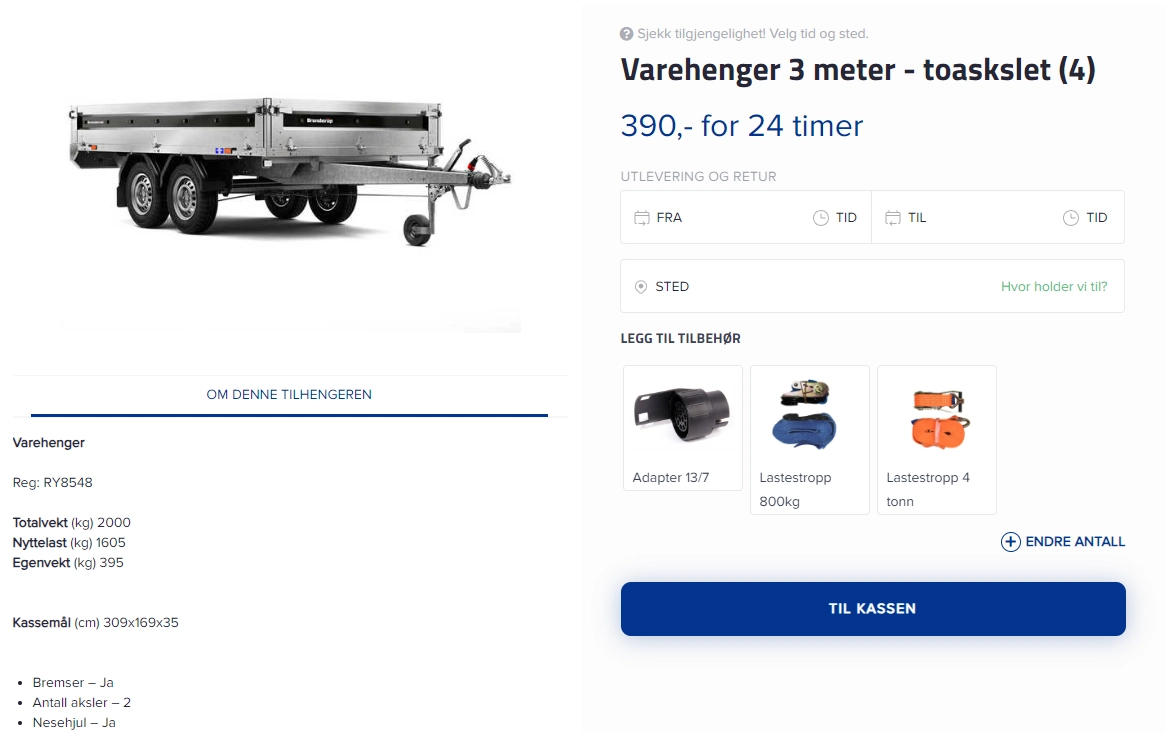
Not all booking software is built for this industry’s specifics — vehicle inspections, damage documentation, license or ID verification, and multi-location fleets are not generic e-commerce problems. A system built for rental commerce should cover:
- A genuinely usable interface — for customers browsing and reserving a unit, and for staff managing bookings day to day
- Real-time fleet availability — so a trailer or van can’t be double-booked across a call center, a website, and a walk-in counter
- Ecosystem integrations — accounting, payments, and ID verification so a booking is not just reserved but verified and paid
- Self-service and keyless options — for operators who want to reduce reliance on staffed reception, covered in more depth in our guide to self-service rental solutions
“The businesses that will win the next decade of vehicle and trailer rental are the ones that let a customer book, verify, pay, and pick up a unit without ever picking up the phone.” — Sharefox Product Team
Traditional Booking vs. Online Self-Service Booking
| Dimension | Traditional (phone/walk-in) process | Online self-service booking |
|---|---|---|
| Availability checking | Manual, staff-dependent, prone to double-booking | Real-time, visible to the customer 24/7 |
| Booking hours | Limited to staffed hours | Around the clock |
| Data entry | Manual re-entry across CRM, booking, and finance tools | Captured once, synced automatically |
| Payment & ID verification | Often handled in person at pickup | Completed online before arrival |
| Staff time per booking | High — phone calls, paperwork, corrections | Low — exceptions and support only |
| Scalability across locations | Requires proportional staff growth | Adds locations without adding headcount |
| Error/no-show rate | Higher, due to manual scheduling | Lower, with automated confirmations and reminders |
Addressing the Concerns That Hold Operators Back
“Our staff isn’t very tech-savvy”
This is one of the most common objections we hear, and it’s a fair one — but it’s also the concern most easily solved by system design rather than training budget. Modern booking platforms are built around the same interaction patterns people already use in everyday consumer apps, which is precisely why onboarding a team usually takes days, not months. Our academy resources walk operators through setup step by step for exactly this reason.
“Is it actually secure for payments and identity checks?”
A rental reservation isn’t just a calendar entry — it’s a financial transaction and, often, a legal agreement. That’s why the security question deserves a direct answer: look for a platform with integrated payment processing and ID verification rather than a booking calendar bolted onto a separate checkout tool. This matters even more for higher-value units like vehicles and commercial trailers, where verifying the renter before handover reduces fraud and damage disputes.
“What happens when something breaks?”
Adoption succeeds or fails on support, not just software. Ask any vendor how quickly they respond when a booking system goes down on a Saturday morning — that answer tells you more than a features list. If you’re comparing options, our pricing page outlines what’s included at each tier, including support response expectations.
Where This Is Heading
Two shifts are shaping the next few years of vehicle and trailer rental. First, automated check-in and check-out — customers unlocking and returning vehicles independently via digital access, reducing idle time between rentals. Second, a continued move toward hybrid and subscription pricing models, which reward operators who can manage recurring billing and flexible terms without manual re-invoicing every cycle.
Operators who’ve already made this shift are a useful reference point. Tilhengerportalen and Håstad Klev Trailer Rental both moved from manual, phone-based booking to self-service online reservations for their trailer fleets — a transition covered in more detail in our related guide on how to start (or grow) a trailer rental business.
If you’re evaluating what this could mean for your own fleet, our ROI calculator is a reasonable starting point, or you can book a demo to see a live system rather than a features page.

 All in one platform