Skip to main content


Is it more climate-friendly to rent a tool than to buy and own one? It’s no longer just a rhetorical question. In spring 2021, rental software provider Sharefox partnered with Norwegian hardware retailer Jernia to put this claim to the test — commissioning students at the Norwegian University of Life Sciences (NMBU) to run a formal Life Cycle Assessment (LCA) on real, commercially available tools.
The results were unambiguous: shifting from ownership to rental can cut emissions dramatically. This article walks through the LCA methodology behind that conclusion, what the Sharefox × Jernia case study actually found, and what it means for anyone evaluating the growing rental economy as a genuine climate strategy rather than a marketing claim.
Understanding Life Cycle Assessment (LCA)
Definition and importance of LCA
Life Cycle Assessment is a standardized methodology — codified in the ISO 14040 and ISO 14044 standards — for evaluating the environmental impacts of a product or service across its entire life, from raw material extraction to end-of-life disposal. This “cradle-to-grave” view is what separates LCA from marketing-driven sustainability claims: every input (energy, water, materials) and output (emissions, waste) is quantified at each stage, so conclusions rest on data rather than assumption.
This matters because a product’s environmental footprint rarely comes from where you’d expect. As the Sharefox × Jernia study shows below, the manufacturing phase — not customer use — is often the single largest source of emissions, which has direct implications for whether renting or owning is the better climate choice.
The four phases of an LCA
| Phase | What happens |
|---|---|
| Goal and Scope Definition | Defines the purpose of the study, the product system, system boundaries, and the functional unit being compared |
| Life Cycle Inventory (LCI) | Collects data on every input and output across the product’s life — energy use, raw materials, transport, emissions |
| Life Cycle Impact Assessment (LCIA) | Translates inventory data into impact categories, such as global warming potential or resource depletion |
| Interpretation | Draws conclusions, flags limitations, and produces recommendations for product or policy decisions |
Types of LCA
| Type of LCA | Typical application |
|---|---|
| Attributional LCA | Quantifies the environmental impact of a product system as it exists today |
| Consequential LCA | Models the environmental consequences of a proposed change — useful for policy or strategic planning |
| Comparative LCA | Directly contrasts two systems, such as a purchased tool versus a rented one (the approach used in the Sharefox × Jernia study) |
| Social LCA | Extends the scope to social impacts, such as labor conditions |
| Life Cycle Sustainability Assessment (LCSA) | Combines environmental, social, and economic impacts into one framework |
The Sharefox × Jernia Case Study: Rental vs. Ownership
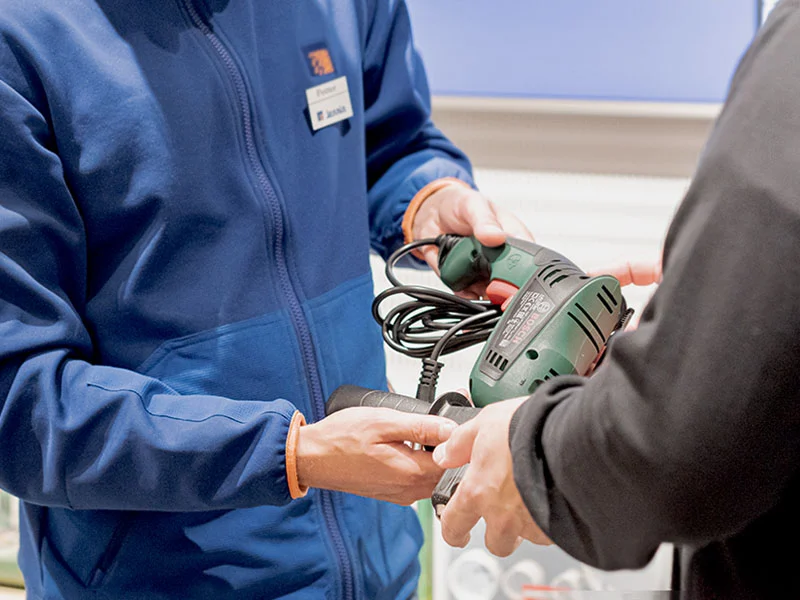
Jernia, a Norwegian hardware and tools retailer, wanted to understand whether offering tools through rental software instead of only selling them could genuinely reduce its climate footprint — not just shift it around. Working with Sharefox, the company gave NMBU researchers access to real product and logistics data for three hobby tools from its range, and asked them to run a comparative LCA.
“We at Jernia want to contribute the best possible to the green shift and create a circular economy. It is therefore an important step for us to rethink how our tools are utilized.” — Andreas Hannevik, Category Manager Services, Jernia
What the numbers showed
| Factor | Ownership system | Rental system |
|---|---|---|
| Tools produced per user (relative) | Substantially more units, since each customer needs their own | Far fewer units, since one tool is shared across many users |
| Production-phase emissions per user | High — each customer’s footprint includes a full manufacturing cycle | Substantially lower — manufacturing emissions are shared across many rental cycles |
| Dominant emission source | Manufacturing (raw material extraction, plastic and steel processing) | Manufacturing and transport between store and customer |
| Sensitive to distance from store | Not applicable | Yes — rental loses its advantage once the round trip becomes long enough |
| Sensitive to usage frequency | Yes — becomes more efficient as annual use increases | Yes — most efficient for infrequent, occasional use |
The clearest signal from the data: because rental pools tool use across many customers, far fewer physical units need to be manufactured overall. Since production — driven by plastic and steel processing — is the single biggest emissions source in a tool’s life cycle, reducing the number of tools made has an outsized effect on total emissions.
Two factors that can flip the result
The study also identified two variables that determine whether rental actually beats ownership in a given situation:
- Transport distance. In a rental model, the customer travels to the store each time they need the tool. Beyond a certain round-trip distance, transport emissions can outweigh the savings from shared manufacturing — meaning rental works best in reasonably dense population areas, and improves further with public transport, EVs, or other low-emission transport options.
- Usage intensity. The analysis assumed a typical owned tool sees fairly light, occasional use. Customers who use a tool considerably more often or for longer than that will find that ownership becomes the lower-emission choice, since their higher usage rate amortizes the same manufacturing footprint more efficiently.
This is a useful nuance for anyone weighing whether to launch a tool rental offering: rental isn’t universally better — it’s better for the specific, common pattern of infrequent, occasional tool use, which describes the vast majority of consumer power tool ownership.
“The life cycle analyses of the students from NMBU clearly emphasize what we have been working on for a long period now: the importance of focusing more on renting rather than owning tools, from an environmental perspective.” — Andreas Hannevik, Category Manager Services, Jernia
Scaling the Impact: What It Would Mean Nationally
To put the findings in perspective, the researchers modeled a national-scale scenario using the large volume of drills imported into Norway in a single year. If those drills had all been rented instead of individually owned, the study estimated a substantial potential reduction in CO?-equivalent emissions at the national level.
For context, Statistics Norway (SSB) publishes comparative emissions figures for transport, including flights. Using that kind of benchmark, the modeled savings from a national shift to drill rental would be roughly equivalent to eliminating a very large number of domestic flights.
This scale of impact is why the circular economy is increasingly treated as a serious climate lever rather than a niche sustainability trend — and why it represents an underused growth opportunity for retail and rental businesses willing to rethink their model.
Beyond Carbon: Resource Use and Overexploitation
Greenhouse gas emissions get the most attention, but they’re not the only environmental cost of manufacturing. Producing tools requires steel, plastic, and other raw materials extracted from finite natural systems. Every unit not manufactured, because it was shared through rental instead, is one less draw on those resources — and one less pressure on the natural habitats that extraction disturbs.
“Life cycle analyses are important to illustrate how changes in consumption can also affect the use of resources in society. The students have done an impressive job showing that the environmental benefits of a rental system can be significant.” — Åsgeir Helland, General Manager, Sharefox
This is also where the transition from an ownership mindset to a usership mindset becomes more than a consumer convenience story — it becomes a resource-efficiency story with measurable environmental returns, as demonstrated in real-world operators like The Tool Shed, which has built its business model around exactly this shared-use principle.

Life Cycle Sustainability Assessment (LCSA)
Life Cycle Sustainability Assessment extends the environmental focus of standard LCA to include social and economic dimensions — labor conditions in manufacturing, economic viability of circular models, and community-level impacts. For a business considering starting a tool or equipment rental operation, an LCSA-informed view helps validate that a rental model isn’t only lower-carbon, but also economically sustainable and socially responsible across its supply chain.
| Industry | LCSA focus area |
|---|---|
| Hardware & tools | Comparing manufacturing footprint, resource extraction, and long-term economic viability of rental vs. ownership |
| Textiles | Comparing fast fashion to durable, repairable, rentable clothing, including labor conditions and circular business viability |
Why This Matters for Rental Operators
The Sharefox × Jernia findings reinforce a pattern seen across other sustainable rental use cases — from construction equipment to dump trailers — where sharing an asset across many users consistently reduces the total number of units that need to be manufactured. For rental businesses, this isn’t just a compliance or reporting talking point; it’s a genuine, LCA-verified differentiator worth communicating to environmentally conscious customers.

 All in one platform