Skip to main content


The rental industry is experiencing a profound transformation, driven by the advent of self-service solutions. This shift empowers businesses to unlock new growth opportunities by streamlining operations, enhancing customer experiences, and expanding their reach beyond traditional models. Below, we break down what self-service rental actually means, where it’s already working, and how operators — from mobility fleets to self-storage sites — can implement it without adding headcount.

Understanding Self-Service in the Rental Industry
Delve into the core concept of self-service within the dynamic rental industry, exploring its definition and the benefits it offers to both businesses and their customers.
Definition of Self-Service Rental Solutions
Self-service rental solutions represent a digital transformation in how customers access and use rental equipment: booking, identity verification, payment, pickup, and return all happen without a staff member present. Sharefox, a digital rental commerce platform, exemplifies this by enabling businesses to run and scale equipment and vehicle rental operations efficiently. The platform covers both B2C and B2B customers, providing self-service booking capabilities that remove the need for constant staff intervention — a model explored in more depth in our dedicated self-service rentals overview.
Benefits of Self-Service in Rentals
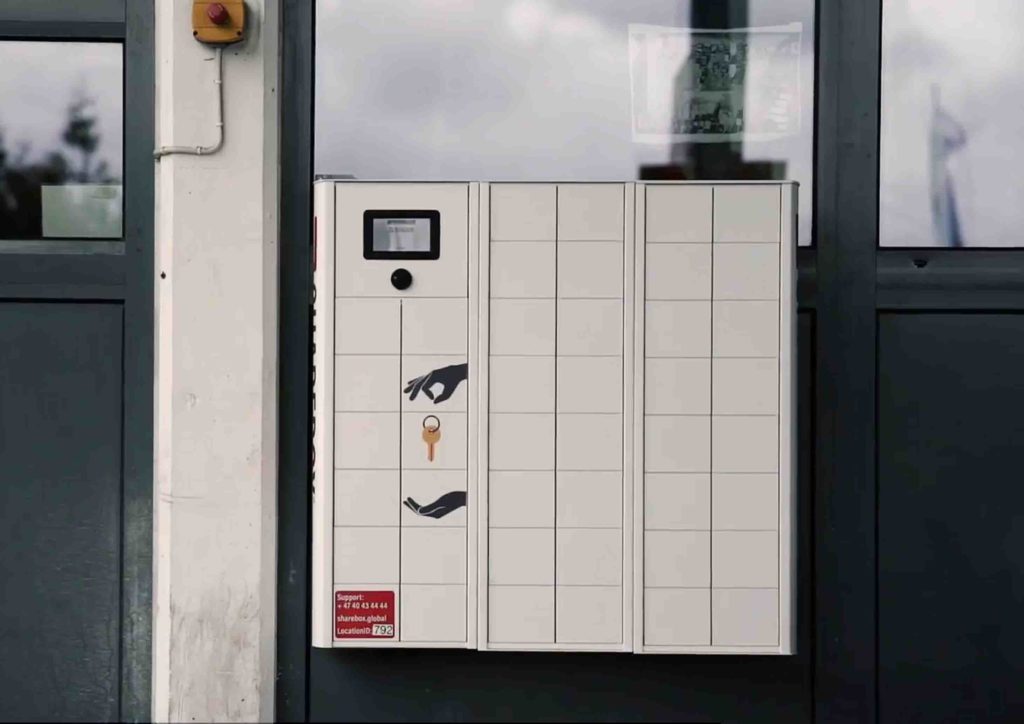
The advantages of self-service are extensive: greater operational efficiency, longer opening “hours” without extra payroll, and higher customer satisfaction. Automation — particularly through self-service check-in/out modules like Sharebox integrations — reduces dependence on a physical reception desk, making operations more agile and allowing a single manager to run several unstaffed locations at once.
“The businesses that win with self-service aren’t the ones who simply remove staff — they’re the ones who redesign the entire customer journey around trust, clarity, and instant access,” notes one European outdoor-equipment rental operator who moved from a staffed kiosk to an app-based, keyless model.
Key Technologies Driving Self-Service Rentals
Robust, integrated technology simplifies every step of the customer journey. A complete rental management system needs full ecosystem integrations — accounting, payments, and ID verification among them. Sharefox’s integrations hub connects booking and inventory management with partners such as Visma (accounting), Nets (payments), and Criipto (ID verification), while built-in analytics and automation surface the insights operators need to keep utilization high.
Self-Service Kayak Rentals: A New Frontier
The rise of self-service has opened new avenues for outdoor recreation, particularly kayak rentals. This model lets paddlers unlock a kayak with a smartphone at a lake or riverside station, no staff required — a use case we’ve mapped in detail for kayak rental operators and in our kayak rental software guide.
How Self-Service Kiosks Are Transforming Kayak Rental
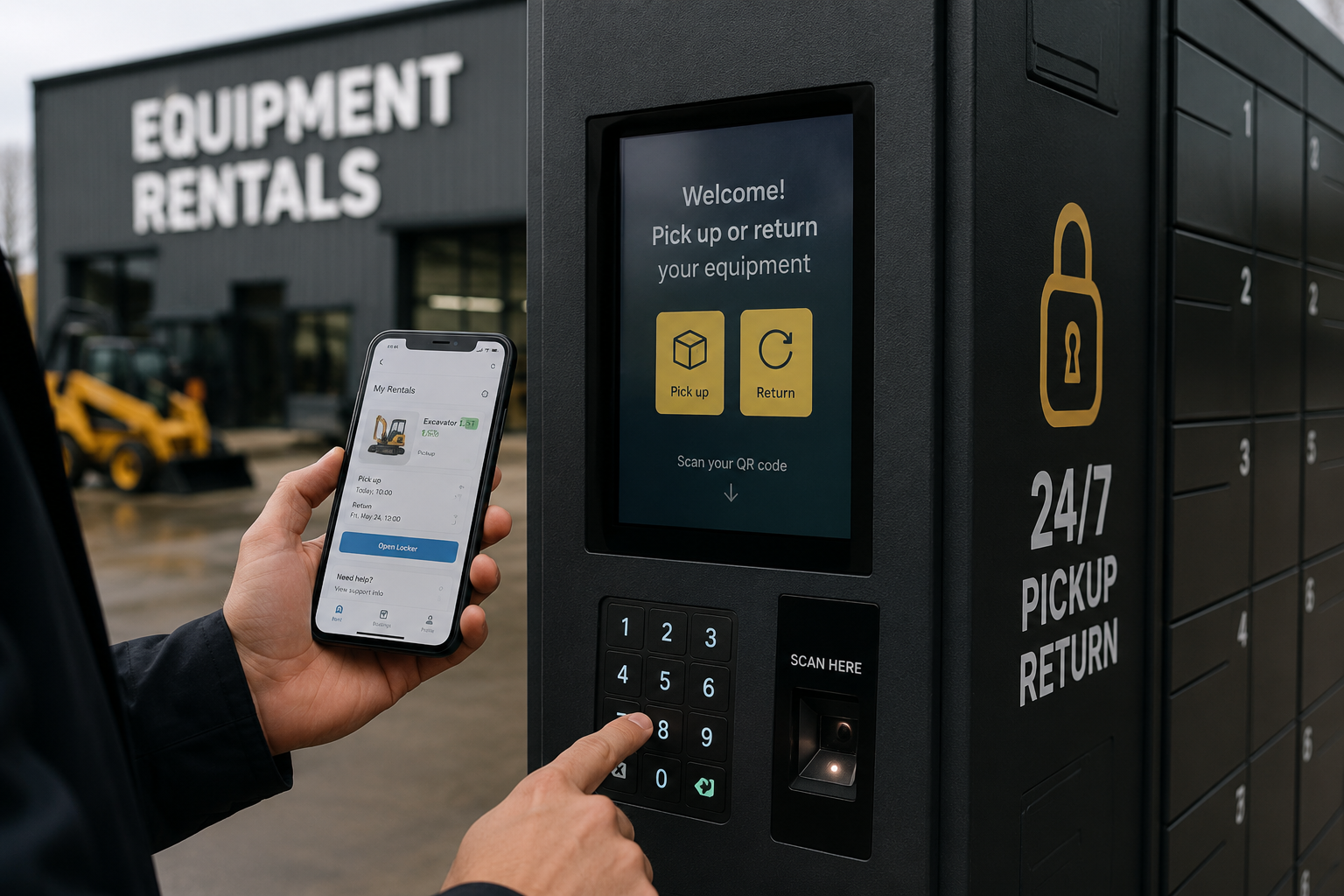
Smart rental stations at waterfront locations let customers find an available kayak, pay securely in an app, then scan a QR code or enter a code to unlock a locker. The entire journey — booking, payment, maintenance reminders, and return — is automated, extending availability to 24/7 and taking the operational burden off staff.
Case Studies: Self-Service in Practice
Urban parks near lakes and rivers, and tourist waterfront destinations, have both seen strong uptake of self-service kayak and paddleboard stations, largely because customers can rent spontaneously without coordinating around opening hours. The same pattern shows up in adjacent verticals — Sharefox’s bicycle rental case study with Baisikeli and the Marbella Rent a Bike case study both illustrate operators scaling a fleet without scaling headcount.
Expanding the Self-Service Model to Other Rentals
Self-Service Paddleboard Rental Solutions
The model extends naturally to paddleboards: a customer uses a mobile app to unlock a locker, grabs the board, and starts their session — no different, technically, from the kayak flow above.
Integrating Bikes and Other Recreational Rentals
Beyond water sports, bike-share and recreational-equipment rentals fit the same pattern. Riders rent through an app, scan a QR code, and unlock the bike, and the station operates autonomously around the clock. Our bicycle rental vertical page and the Marbella Rent a Bike case study go deeper into how this plays out for real operators.
Benefits of a Diverse Self-Service Rental Station
Consolidating kayak, paddleboard, and bike rentals at a single station gives customers a wider menu of equipment in one visit and gives the operator MultiCommerce flexibility to rent, sell, and subscribe from the same platform. That combination turns a simple rental point into a genuine outdoor-adventure hub.
Comparing Traditional and Self-Service Rental Models
| Factor | Traditional (Staffed) Rental | Self-Service Rental |
|---|---|---|
| Availability | Limited to staffed opening hours | 24/7, subject to equipment supply |
| Staffing cost per location | Fixed cost regardless of demand | Largely automated; staff shared across sites |
| Customer check-in/out | Manual, in person | App/QR-code based, self-directed |
| Identity & payment verification | Manual paperwork or POS | Digital ID verification and online payment |
| Scalability (new locations) | Slow — needs hiring and training | Faster — mainly a hardware/software rollout |
| Peak-time bottlenecks | Common (queues, staff availability) | Rare — multiple customers served in parallel |
| Data on utilization | Often manual or fragmented | Centralized, real-time analytics |
Implementing Self-Service Rental Stations
Choosing the Right Location for Rental Stations
Location strategy differs by role:
| Role | Optimal Location Types |
|---|---|
| Fleet, courtesy-car, or mobility managers | Accessible spots in urban centers or near transport hubs |
| Entrepreneurs building subscription or hybrid rental models | Near recreation areas or residential communities, prioritizing visibility |
| Self-storage or property managers scaling fast | High-traffic areas or existing facility footprints |
Design Considerations for Self-Service Kiosks
A well-designed kiosk — often built on tools like Sharebox integrations — should be intuitive, with clear instructions, a responsive touchscreen, and a secure flow for payment and identity verification. For outdoor installations, the hardware also needs to be weather-resistant enough for continuous, reliable operation. Sharefox’s subscription rental software page covers how to layer recurring billing onto this same kiosk experience where it makes sense.
Marketing Strategies for Self-Service Rentals
Messaging should match the audience: rental operators can lead with 24/7 availability; mobility managers can emphasize reduced administrative burden; self-storage and property managers can highlight fast, low-friction expansion; and digital agencies or integration partners will respond best to transparency around technology and support. Our free resource on scaling a rental business walks through several of these positioning angles in more detail.
The Future of Self-Service Rentals
Emerging Trends in Autonomous Rental Solutions
Expect deeper integration of AI and IoT within self-service stations — equipment that reports its own availability and maintenance needs, and eventually autonomous delivery bringing rental items directly to the customer. Sharefox’s whitepaper on the future of self-service rentals explores several of these scenarios in more depth.
Potential Challenges and Solutions in Self-Service Rentals
| Role | Common Challenge | Practical Fix |
|---|---|---|
| Rental operators | Fragmented tools, double work, poor visibility into bookings/damages/availability | A unified platform that centralizes booking, inventory, and maintenance data |
| Mobility managers | Multiple systems, manual key handling | Digital, app-based unlock replacing physical key handoff |
| Self-storage managers | Balancing rapid growth with operational efficiency | A scalable platform that adds locations without adding admin overhead |
| Digital agencies | Need for clear partner models and transparent pricing | A published partner program with defined terms |
Predictions for the Future of the Rental Business
Expect a continued shift toward subscription-based and hybrid rental models, more predictive-maintenance tooling built into rental platforms, and self-service stations spreading into more urban and recreational locations — making renting equipment, from bikes to specialized tools, an ordinary part of daily life rather than a planned errand. If you want to see how this looks in your own numbers, Sharefox’s ROI calculator is a reasonable starting point, and our team is happy to walk through it on a demo call.

 All in one platform