Skip to main content


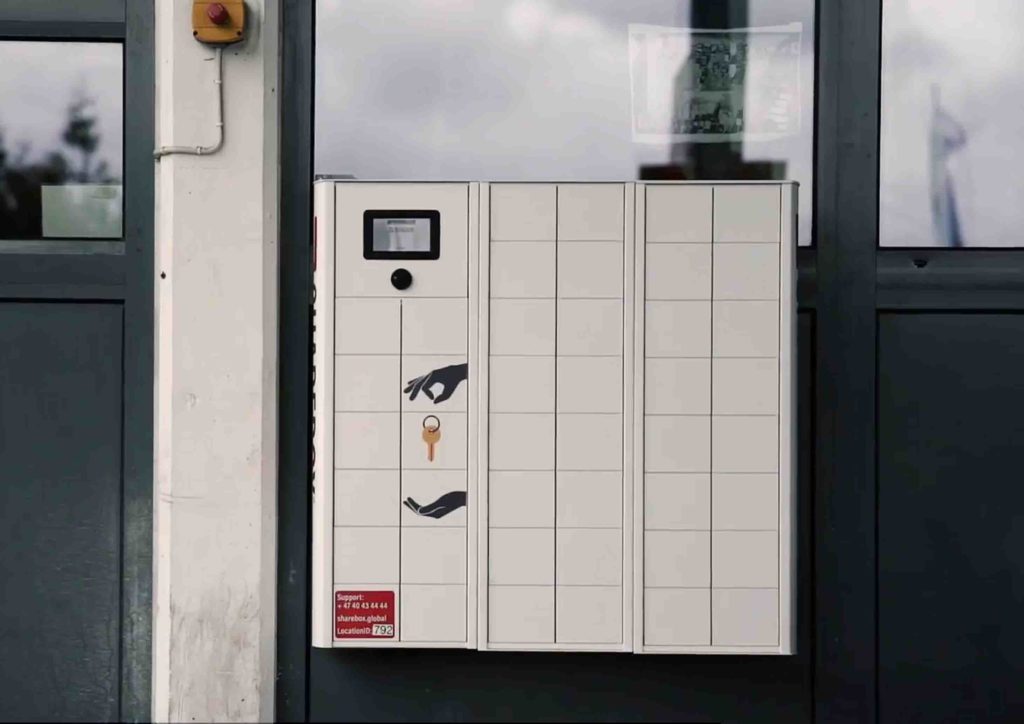
The rental industry is in the middle of a quiet but permanent shift. Renters no longer want to wait in line for a set of keys or a locker code — they want to book, verify their identity, pay, and pick up an asset on their own schedule, often from their phone. That shift has a name: self-service rental. And two names come up constantly in connection with it — ShareBox and Sharefox.
This guide explains what self-service rental actually means in practice, how ShareBox and Sharefox fit together (they’re not competitors — one is a check-in/out hardware integration, the other is the commerce platform it plugs into), and what operators across car rental, equipment, and self-storage should weigh before automating their operations.
What “self-service” actually means in rental
Self-service in rental doesn’t mean removing the human element entirely — it means removing the parts of the transaction that don’t need a person standing behind a counter. In a modern setup, a customer can typically:
- Browse availability and book online, any time of day
- Verify their driver’s license or ID digitally
- Pay and put down a deposit securely
- Unlock a vehicle, locker, or storage unit using a phone or PIN
- Return the asset and close out the agreement without staff present
According to McKinsey & Company’s research on car subscriptions, convenience and flexibility are now primary drivers of how consumers choose mobility services — a trend that self-service infrastructure is built to serve directly.
“The moment we removed the front desk from the pickup experience, our average turnaround time dropped and our team stopped being the bottleneck between a booking and a car actually leaving the lot.” — a mobility fleet operations manager, on the shift to self-service check-in/out
Where ShareBox and Sharefox each fit
This is the single most common point of confusion for operators researching this space, so it’s worth being precise about it.
Sharefox is the rental management software — the platform that runs booking, inventory, pricing, invoicing, and customer accounts for equipment, vehicle, and self-storage rental businesses, across both B2C and B2B.
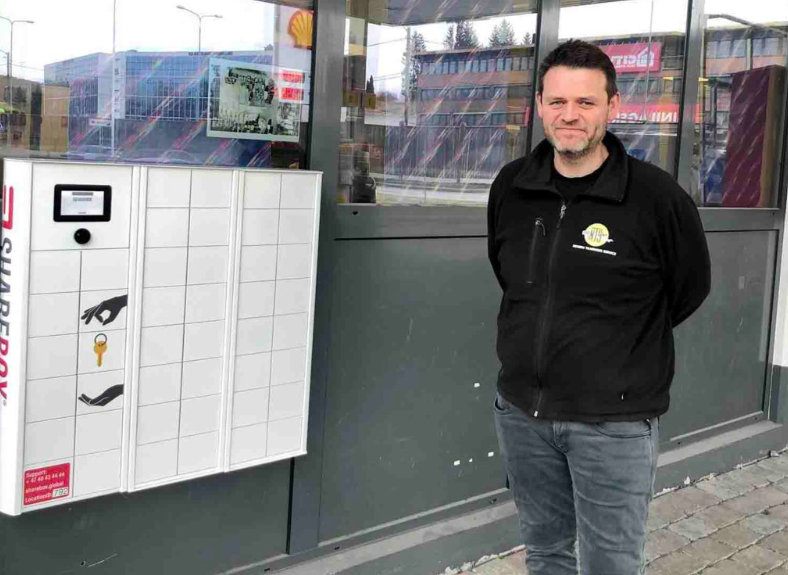
ShareBox is a self-service check-in/out hardware and access integration — one of several options (alongside Inlet) that plug into Sharefox to handle the physical unlock/return step: verifying ID, confirming payment status, and releasing access to a vehicle, locker, or unit.
In short: Sharefox is the system of record and the storefront; ShareBox is one of the physical access layers that connects to it.
| Sharefox | ShareBox | |
|---|---|---|
| What it is | Digital rental commerce & management platform | Self-service check-in/out access integration |
| Core job | Booking, inventory, pricing, invoicing, customer accounts | Unlocking/releasing physical access to an asset |
| Best fits | Equipment, vehicle, and self-storage operators managing an entire rental business | Operators who need automated pickup/return at a physical location |
| Customer type | B2C and B2B | Consumers picking up/returning a physical asset |
| Works alongside | ShareBox, Inlet, payment & ID verification providers | Sharefox (or another compatible rental platform) |
Why operators are automating check-in and check-out
For a mobility manager, automating pickup and return isn’t just about customer convenience — it directly affects fleet turnaround. Every minute a vehicle sits idle waiting for a staff-assisted handover is a minute it isn’t generating revenue. Kiosk- and app-based self-service typically brings together:
- ID verification, so a license or ID is checked before an asset is released
- Secure payment processing, so deposits and charges are handled without manual entry
- 24/7 access, removing the constraint of staffed opening hours
Deloitte’s Global Automotive Consumer Study has repeatedly found that consumers rank convenience and digital access among their top expectations for mobility services — reinforcing why this isn’t a niche feature but a baseline expectation.
The role of the app in self-service rental
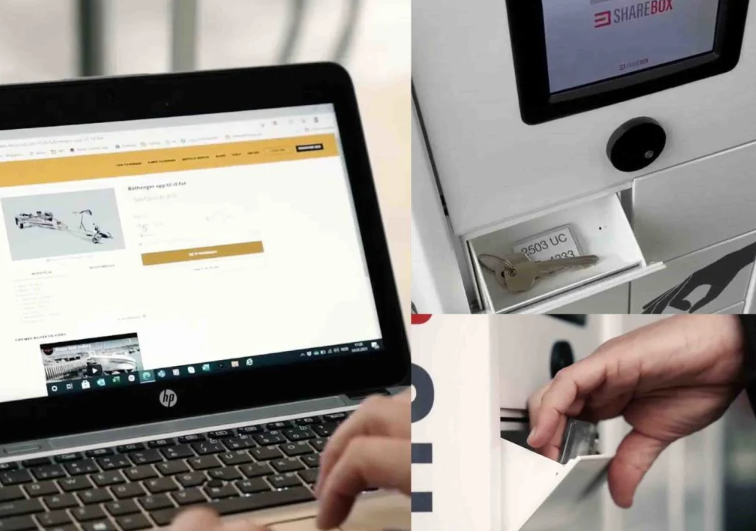
The mobile app is usually the front door to this whole experience. A well-built app lets a renter locate an available asset, make a reservation, complete ID and payment steps, and unlock a car, locker, or piece of equipment directly from their phone — all synced in real time with the back-end rental software. That real-time sync matters: it’s what prevents double-bookings and keeps inventory management accurate across every channel a business sells through.
Beyond car rental: where else self-service applies
Self-service didn’t stay confined to car rental for long. The same building blocks — booking, ID/payment verification, automated access — now show up across:
- Equipment and tool rental, for operators managing scheduled pickups without full-time counter staff
- Self-storage, where tenants expect to rent a unit and gain access without ever meeting an employee
- Subscription-based mobility, where recurring access replaces one-off transactions — see our guide to subscription rental software
For a deeper walkthrough of the keyless side specifically, see our guide to self-service and keyless car rental.
What to weigh before implementing self-service
Automation isn’t a single flip-the-switch decision. Before implementing a self-service model, it’s worth mapping out:
- Which integrations you actually need — check-in/out hardware, payment gateway, ID verification — and confirming they connect cleanly to your platform via integrations.
- Your pricing structure — subscription, short-term, long-term, or hybrid — since self-service changes how and when customers pay. Sharefox’s pricing page breaks down how plans scale with feature needs.
- Staff transition — self-service reduces headcount needs at the counter but usually increases the need for remote support and monitoring.
- Customer education — even the smoothest kiosk or app needs a short onboarding moment the first time a customer uses it.
If you’re evaluating whether this fits your operation, a demo walkthrough is generally the fastest way to see how booking, access, and payment connect end-to-end for your specific asset type.


 All in one platform