Skip to main content


Walk into any dealership’s back office on a busy Saturday morning and you’ll usually find the same scene: a salesperson flipping through a pegboard of keys, a service advisor waiting on a loaner, and a manager trying to remember who signed out the demo car on Thursday. Multiply that by a large lot and a dozen staff members, and it’s easy to see why key management is one of the most underrated operational problems in the retail automotive business.
This article looks at how dealerships are moving away from pegboards and paper logs toward structured key control systems — what they actually solve, what to look for, and where the technology is heading. It draws on published industry research, publicly available loss-prevention data, and patterns we’ve seen across dealership groups managing everything from single-location used-car lots to multi-site franchise operations.
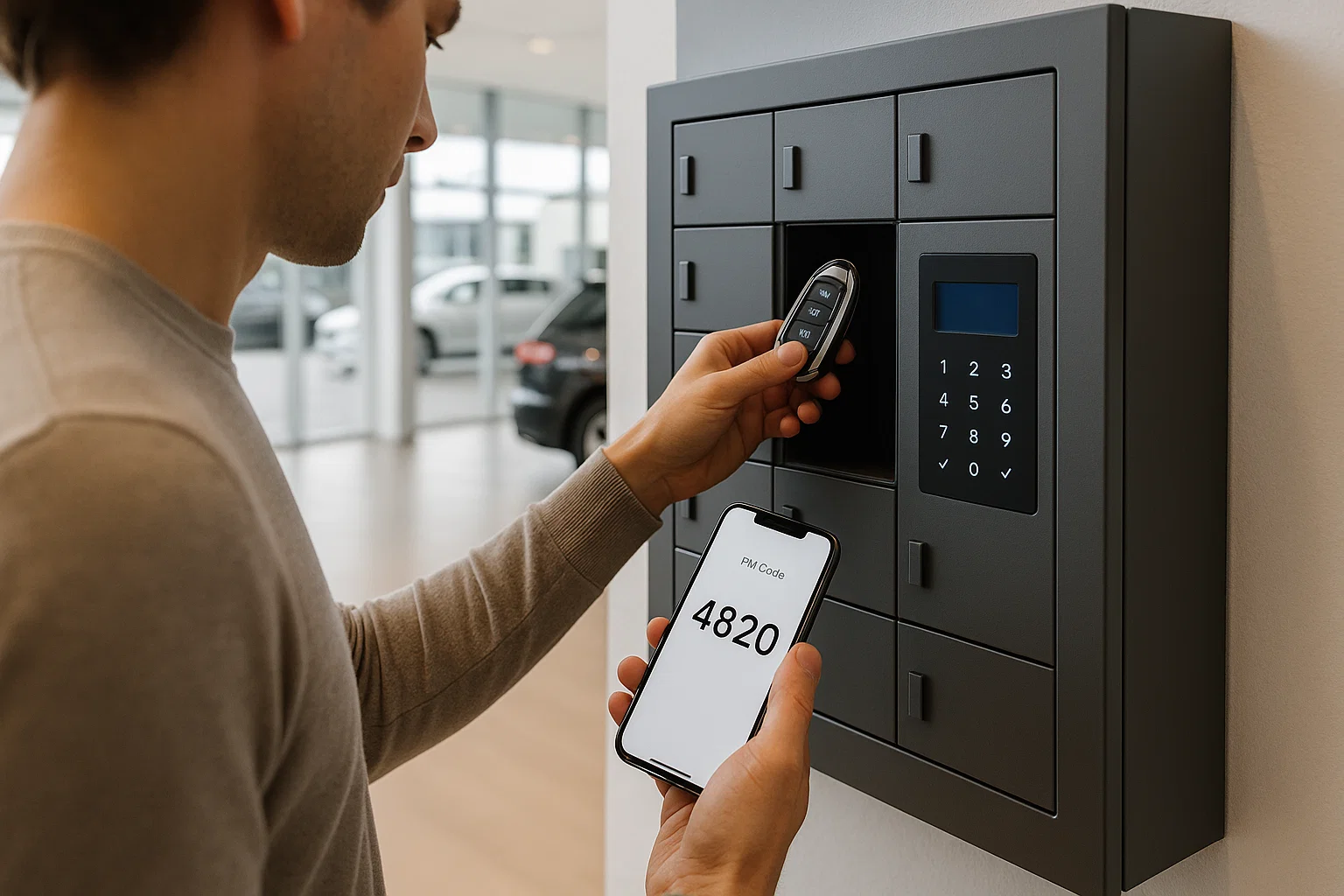
Understanding Key Management in Dealerships
What Is Key Management?
Key management, in a dealership context, is the end-to-end process of organizing, securing, and tracking every vehicle key on the premises — from the moment a new unit arrives on the lot to its retrieval for a test drive, a service appointment, or a detail job. Done well, it means every key has a known location, a known custodian, and a timestamp for both. Done poorly, it means lost afternoons, frustrated customers, and — in the worst cases — a car that quietly leaves the lot without anyone signing for it.
The Importance of Key Control Systems
A dealership’s inventory is its largest asset, and the keys are effectively the access layer to that asset. Without a reliable key control system, even a well-run store can lose hours a week to misplaced keys, delayed test drives, and service bays sitting idle while someone hunts for the right fob. A properly implemented system does more than prevent that friction — it creates an audit trail: a record of who accessed which key, when, and for how long. That record matters for insurance, for internal accountability, and increasingly for compliance with dealer-bond and franchise requirements.
Key Tracking Systems Explained
Key tracking systems are the operational core of modern dealership key management. Depending on the setup, these can range from simple numbered slots with sign-out sheets to electronic cabinets with PIN or biometric access and full digital logging. An electronic key management system lets staff locate a specific key in seconds, assign it to a client for a test drive, and confirm its return automatically — removing the guesswork that paper logs can’t eliminate. This is closely related to the shift many vehicle rental and mobility operators have made toward digital, self-service access more broadly.
Automotive Key Management Solutions
Types of Key Management Systems
There isn’t a single “correct” system — the right choice depends on lot size, staff count, and risk tolerance. Broadly, dealerships choose between three tiers:
| System type | How it works | Best for | Main trade-off |
|---|---|---|---|
| Mechanical key cabinet | Numbered slots or pegs, manual sign-out sheet | Small lots with a limited team and tight budgets | No automatic audit trail; relies on staff discipline |
| Electronic key management system | PIN/badge or biometric access, digital log of every check-out and return | Mid-to-large dealerships, multi-department access (sales, service, detail) | Requires upfront investment and staff onboarding |
| Fully automated / self-service key systems | ID verification, digital agreements, and payment handled without staff involvement | High-volume lots, courtesy car fleets, after-hours access | Highest setup complexity; needs integration with DMS/booking tools |
Benefits of Electronic Key Management
The case for electronic systems is largely about removing variance from a process that used to depend entirely on individual staff habits. Real-time tracking cuts down on lost keys, gives managers a live view of where every vehicle key sits at any moment, and shortens the time between “customer wants to test drive” and “customer is behind the wheel.” That last point matters more than it sounds — a slow handoff is one of the more common, avoidable friction points in the sales process.
“The keyboard used to be the bottleneck of our whole sales floor. Once we moved to an electronic system with a proper audit trail, we stopped losing ten to fifteen minutes per test drive just looking for the right fob — and we finally had a record of who had which car, every time.”
— Operations Manager, mid-size franchise dealership group
Choosing the Right Dealer Key System
When evaluating options, weigh fleet size, staff headcount, and how many departments need access (sales, service, detail, and finance all touch keys differently). Look for a system that integrates with your existing dealership management system (DMS) rather than running as a disconnected silo — that integration is usually what determines whether the audit trail is actually useful or just another spreadsheet nobody checks.
Streamlining Access with Smart Key Technology
Features of Fully Automated Key Systems
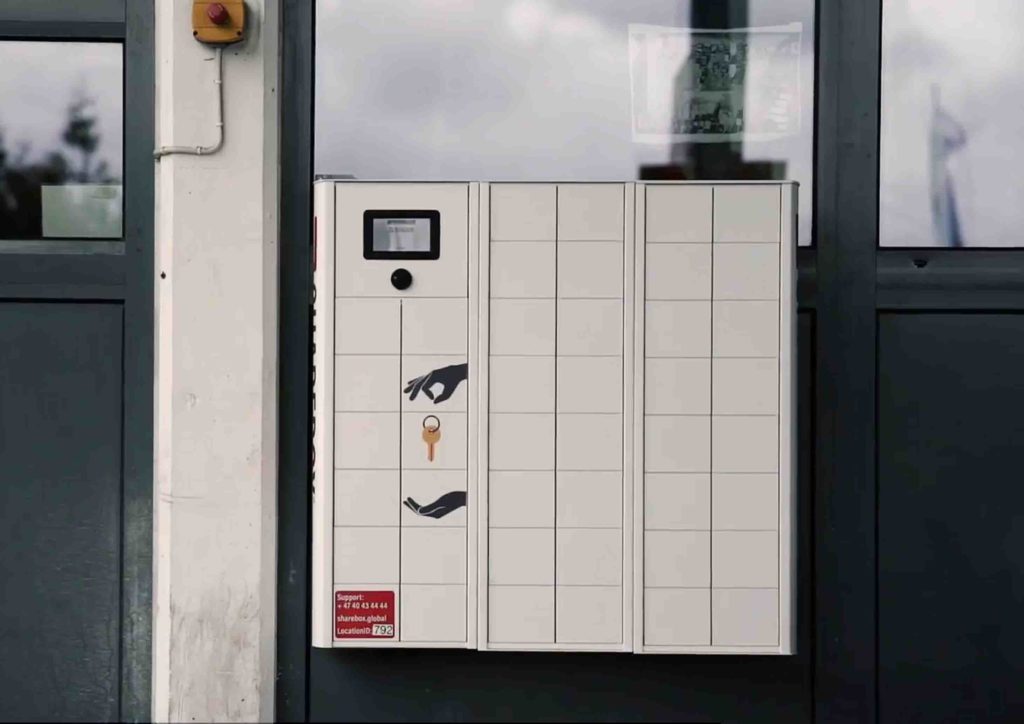
Fully automated key systems take the concept further, handling check-in and check-out digitally so customers can, in some setups, book and collect a vehicle with minimal staff involvement. This model — increasingly common in keyless, self-service vehicle access — bundles ID verification and payment into the same flow, which shortens turnaround and keeps vehicles moving instead of sitting idle waiting on paperwork.
Real-Time Tracking of Vehicle Keys
Real-time visibility is the feature dealerships notice the most once they have it. Instead of a manager asking “does anyone know where the keys to unit 214 are?”, the system answers immediately — who has it, since when, and when it’s due back. This is especially useful for courtesy car and loaner fleets, where vehicles rotate between customers constantly and a missed return can cascade into a scheduling problem for the whole service department.
Integrating Smart Keys into Dealership Operations
For dealership groups managing multiple locations or expanding into vehicle subscription or flexible-access models, smart key integration becomes less of a convenience and more of an operational requirement. Automating check-in/check-out, verifying IDs digitally, and tying access to payment status all reduce the manual overhead that otherwise scales badly as fleet size grows.
Enhancing Security and Efficiency
Preventing Lost Keys with Effective Management
Lost or unaccounted-for keys aren’t just an inconvenience — they’re a security exposure. The National Insurance Crime Bureau has repeatedly flagged vehicle theft facilitated by improperly secured keys as a recurring, preventable loss category for dealers and rental operators alike. A key control system with a genuine audit trail is one of the more cost-effective mitigations available, since it removes the anonymity that makes internal or opportunistic theft easier.
Key Slots and Their Role in Key Control
Whether mechanical or electronic, individual key slots remain the physical foundation of key control. Each slot holding one key or key tag creates a clear visual (and, in electronic systems, digital) record of what’s present and what’s missing — a simple mechanism, but one that underpins everything else in the system.
ROI of Implementing Key Tracking Solutions
For a mobility or operations manager evaluating the business case, the return usually shows up in two places: staff time recovered from searching for keys, and reduced vehicle idle time between customers. A system that scales across multiple locations — rather than one built for a single lot — also avoids the cost of re-implementing a new process every time the dealership group grows, which is worth factoring in alongside broader fleet management practices.
Case Studies and Best Practices
Successful Implementations of Key Management Solutions
Dealerships that have moved from manual to electronic key management consistently report the same pattern: fewer lost keys, faster test-drive turnaround, and a usable audit trail instead of an ignored logbook. It’s worth comparing platforms directly — resources like this comparison of car rental and dealership software providers can help narrow the field before committing to one system.
Lessons Learned from Automotive Dealerships
The most consistent lesson from dealerships that have made the switch is that manual processes fail quietly. A pegboard doesn’t flag a missing key until someone needs that specific car — by which point the delay has already happened. An electronic key management system surfaces the problem the moment it occurs, which is the difference between prevention and damage control.
Future Trends in Key Management for Dealerships
Expect continued movement toward biometric access, tighter DMS integration, and predictive tools that flag unusual check-out patterns before they become losses. As automotive retail continues shifting toward subscription and flexible-access models, key systems are increasingly expected to plug into that broader digital experience rather than sit apart from it.

 All in one platform