Skip to main content


The Schedule has received some huge updates, and we believe that many rental businesses will get a lot of value from using it. In this product update, the Schedule is in focus, but we also share our new location and time search for your front page.
Here’s a brief overview of what’s new, why it matters, and how to start using it today.
Why This Update Matters
Rental businesses live or die by how well they can see what’s booked, what’s available, and what’s coming next. A scheduling tool that’s hard to read costs real money — in double-bookings, idle inventory, and staff time spent double-checking availability. This release focuses squarely on that problem: making the Schedule faster to scan, easier to act on, and more flexible for how different rental operators actually work.
If you’re new to rental scheduling tools generally, our guide on why a booking calendar is a must-have for growing rental businesses explains the fundamentals before diving into what’s new below.
| Update | Where to find it | Why it matters |
|---|---|---|
| Names on Bars | Schedule (default view) | See who booked what without clicking in |
| Compact View | Schedule → Settings icon | Fit more rows on screen for large inventories |
| Hide Product Totals | Schedule → Settings (below Compact View) | Focus on inventory-item bookings, not product totals |
| “Today” Button Fix | Monthly / Weekly view | Jumps straight to today’s date, no scrolling |
| Show Inventory Fix | Schedule → Settings | Your setting now saves between sessions |
| Drag-and-Drop Reassignment | Schedule → Settings → Show inventory | Maximize utilization by moving orders between inventory items |
Significant Updates to the Schedule
Names on Bars
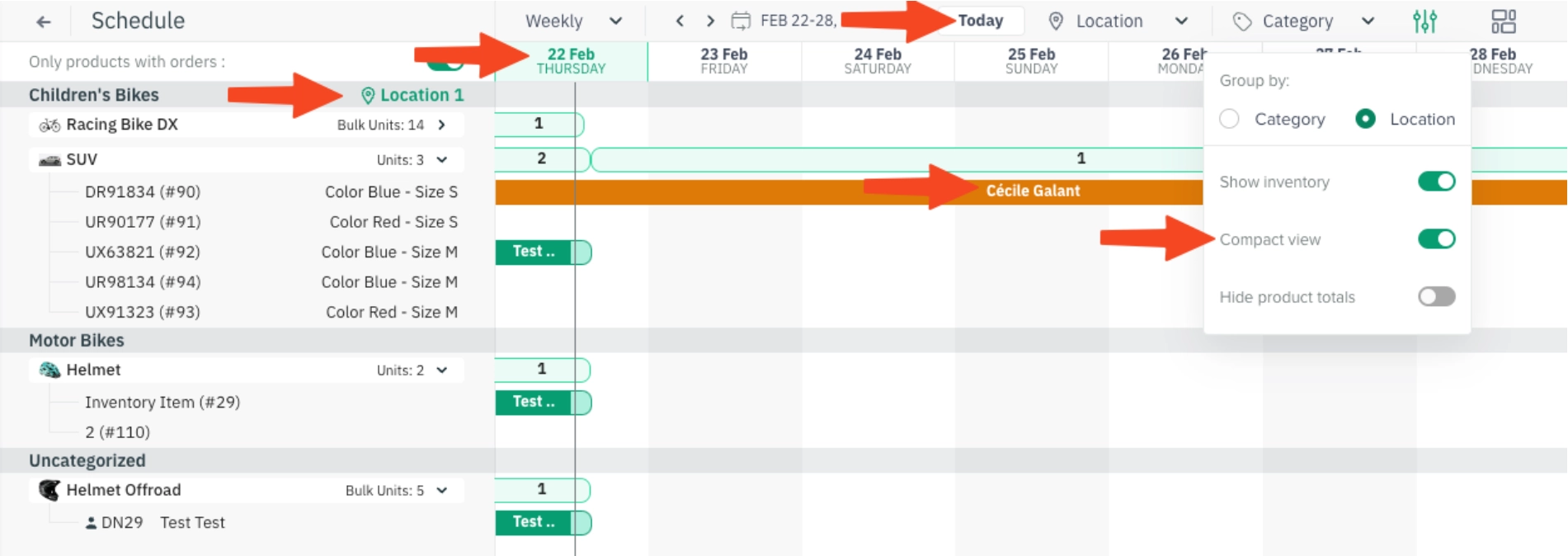
The Schedule now displays the names of individuals or companies who have made bookings, offering you a clearer insight into who has rented and when. No more clicking into every booking bar just to confirm who it belongs to — the information is visible at a glance.
Compact View
For those with extensive product or inventory lists, navigating the Schedule just got easier. The new Compact View allows more information to be displayed vertically, improving overall visibility. Head over to Schedule → Settings icon, and give it a try.
Some companies don’t care too much about totals per product, but rather focus on bookings per inventory item. If that sounds like your business, you’ll also find a toggle for “Hide product totals” right beneath the Compact View setting. Activating this removes the green bars showing the total number of items booked for a product type, giving you a more focused view of individual inventory items.
Pro tip: Using the compressed view together with the “Yearly” view can give you a great visual overview of the current and past year — helping you optimize your product assortment before the next season starts.
“Today” Update
If you’ve selected the “Monthly” or “Weekly” view and press the “Today” button, the calendar will now start from today’s date, instead of leaving you to scroll back to find it.
Fix for “Show Inventory”
We’ve fixed an issue where the “Show inventory” setting wasn’t saved between sessions. Your preferences will now be remembered every time you log back in.
Drag-and-Drop to Change Assigned Inventory
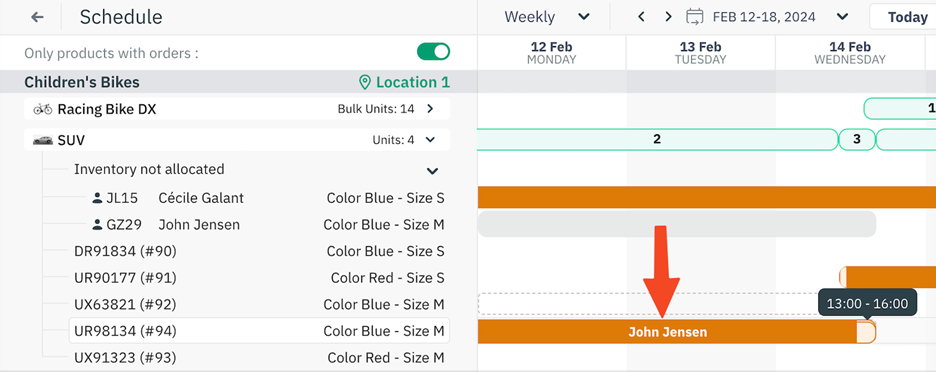
In the Schedule, you can now drag and drop an unassigned order down to an inventory ID under the same product. You can also drag and drop orders between a product’s inventory items. This helps you maximize utilization — moving orders from one item to another to free up space for longer bookings.
Maybe your company doesn’t currently assign orders to specific inventory items? If not, this could be a good time to start. Go to Schedule → Settings button → Show inventory, and give it a try. It helps to give your inventory items unique names or numbers first — our inventory management system guide walks through how to set that up.
Stay tuned — drag-and-drop between different products is shipping within a few weeks.
Standard View vs. Compact View: Which Should You Use?
Front Page Location & Time Search
With the introduction of Shop 2.0, customers can now specify their desired location and pickup/return times right from the start. This is handy if your customers are very specific about which location, or which times, they want to rent your products.
Contact support@sharefox.no if you’d like this set up for your shop.
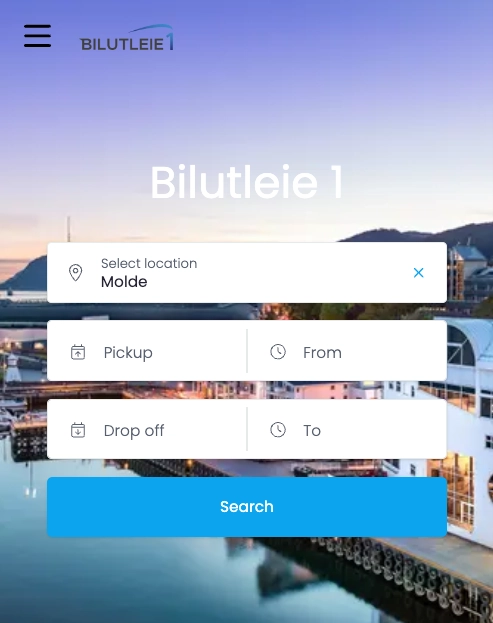
Note: In some cases, the customer should ideally select the product first, and see its availability in the calendar, before setting exact pickup/return times — which can otherwise limit the search too much. If your customers care more about the specific product than the specific time, the front-page search may not be the ideal fit for your shop. You can also choose to include only the Location selector on your front page, if you prefer. Our Rental Booking Software page covers the different booking-flow options available.
Best Practices: Getting the Most Out of This Update
A feature is only as valuable as its adoption. A few recommendations from our Customer Success team:
- Segment your rollout internally. Power users on your team (schedulers, warehouse staff) will want the drag-and-drop and Compact View details; front-desk staff mainly need the “Names on Bars” change.
- Use in-app discovery. The Settings icon inside the Schedule is the fastest way for your team to find these toggles without a training session.
- Revisit your pricing and season strategy once you’ve used Compact View with the Yearly view for a full season — it often reveals under-used inventory.
- Check your integrations are still aligned after any workflow change — see our Integrations overview if you’re connecting accounting, payments, or ID verification tools.
As one industry analysis of rental and subscription commerce puts it:
“Operational visibility — knowing exactly what is available, where, and when — is one of the clearest differentiators between rental businesses that scale profitably and those that plateau.” — McKinsey & Company, Car subscriptions: Tomorrow’s mainstream?
While that research focuses on vehicle subscriptions specifically, the same principle holds for equipment, tools, and self-storage rental operators, which is exactly the gap the new Schedule views are designed to close. If subscriptions are part of your model, our guide on subscription management software is a useful next read.
Previous Updates
Did you miss our previous product updates? Read up on them here, including our most recent Product Update — March 2024 and our broader look back at 2025’s product updates.

 All in one platform