Skip to main content



Inventory is the backbone of any business that buys, sells, or rents physical goods — and for rental operators specifically, it’s also the asset that generates every dollar of revenue. Choosing the wrong system doesn’t just create admin headaches; it directly caps how much utilization, and therefore income, you can squeeze out of each item you own. This guide breaks down the main categories of inventory management software available today, what each one is actually good for, and how to decide which tier fits your business as it grows.
What Is an Inventory Management System, and Why Does It Matter?
An inventory management system is software that tracks, organizes, and controls stock across locations and stages of the supply chain — from the moment an item arrives in a warehouse to the moment it’s sold, rented, or shipped out. For straightforward retail or wholesale operations, that might mean stock counts and reorder points. For businesses that rent out physical assets — vehicles, tools, equipment, or storage units — inventory management is more complex, because the same item needs to be tracked through repeated booking cycles, availability windows, maintenance schedules, and depreciation, not just a single sale.
This is where purpose-built platforms diverge sharply from generic stock-tracking tools. A complete rental management system needs to support both B2C and B2B customers with self-service booking, flexible pricing, and integrations into the rest of the business stack — capabilities that standard inventory software was never designed to handle.
“Rental and subscription models are no longer a niche play — they represent one of the fastest-growing categories in mobility and asset-based commerce, precisely because they let companies monetize utilization rather than just ownership.” — McKinsey & Company, “Car subscriptions: Tomorrow’s mainstream?”
Key Features to Look For
Whatever industry you’re in, a genuinely capable inventory management platform should offer:
- Booking and inventory management in one unified view
- Self-service check-in/check-out for customers
- Support for both short-term and long-term rental cycles
- Subscription billing alongside one-off sales and service bookings
- Integrations with accounting, ID verification, and payment systems
More advanced platforms — including Sharefox’s rental booking software — add MultiCommerce flexibility for hybrid business models, advanced pricing configuration, and built-in analytics and automation, which matters increasingly as operators scale past a single location or product line.
The Main Types of Inventory Management Systems
Not every business needs the same depth of functionality, and matching your system to your stage of growth avoids both under- and over-investing. Broadly, the market splits into three tiers.
1. Free and Entry-Level Inventory Tools
For very small businesses or early-stage startups, free inventory tools offer a foundational layer: basic stock-level tracking, simple order management, and elementary reporting. They’re a reasonable starting point for gaining initial visibility into stock, but they typically lack real-time updates across multiple locations, automated reordering, or any support for rental-specific workflows like recurring bookings or asset depreciation.
2. General-Purpose Inventory Platforms
As operations mature, businesses often move to general cloud-based inventory systems such as Zoho Inventory. These tools are genuinely useful for retail and wholesale businesses, offering multi-location tracking, barcode scanning, and integrations with common ERP and accounting software. Where they fall short is specialization: a generic platform built for selling products once doesn’t natively understand the operational logic of renting the same item out repeatedly — availability calendars, damage tracking, recurring billing, and utilization-based pricing aren’t first-class features.
3. Advanced, Industry-Specific Rental Commerce Platforms
For equipment, tool, vehicle, and self-storage rental operators specifically, purpose-built platforms close that gap. Sharefox, for example, is built around the rental lifecycle from the ground up — booking, inventory, invoicing, and customer self-service in a single system — rather than retrofitting features onto a generic e-commerce or stock-tracking foundation. This is the tier where sophisticated equipment rental software, vehicle rental software, and self-storage software live.
Comparing the Three Tiers
| Feature | Free / Entry-Level | General Inventory (e.g. Zoho) | Industry-Specific Rental Platform (e.g. Sharefox) |
|---|---|---|---|
| Basic stock tracking | Yes | Yes | Yes |
| Multi-location inventory | No / limited | Yes | Yes |
| Real-time availability updates | No | Partial | Yes |
| Recurring booking / rental calendar | No | No | Yes |
| Self-service check-in/check-out | No | No | Yes |
| Subscription billing | No | Limited | Yes |
| Accounting & ID verification integrations | No | Partial | Yes |
| Industry-specific pricing & automation | No | No | Yes |
| Best suited for | Startups testing the waters | General retail/wholesale | Equipment, vehicle, tool, self-storage rental operators |
How Inventory Management Systems Streamline Order Fulfillment
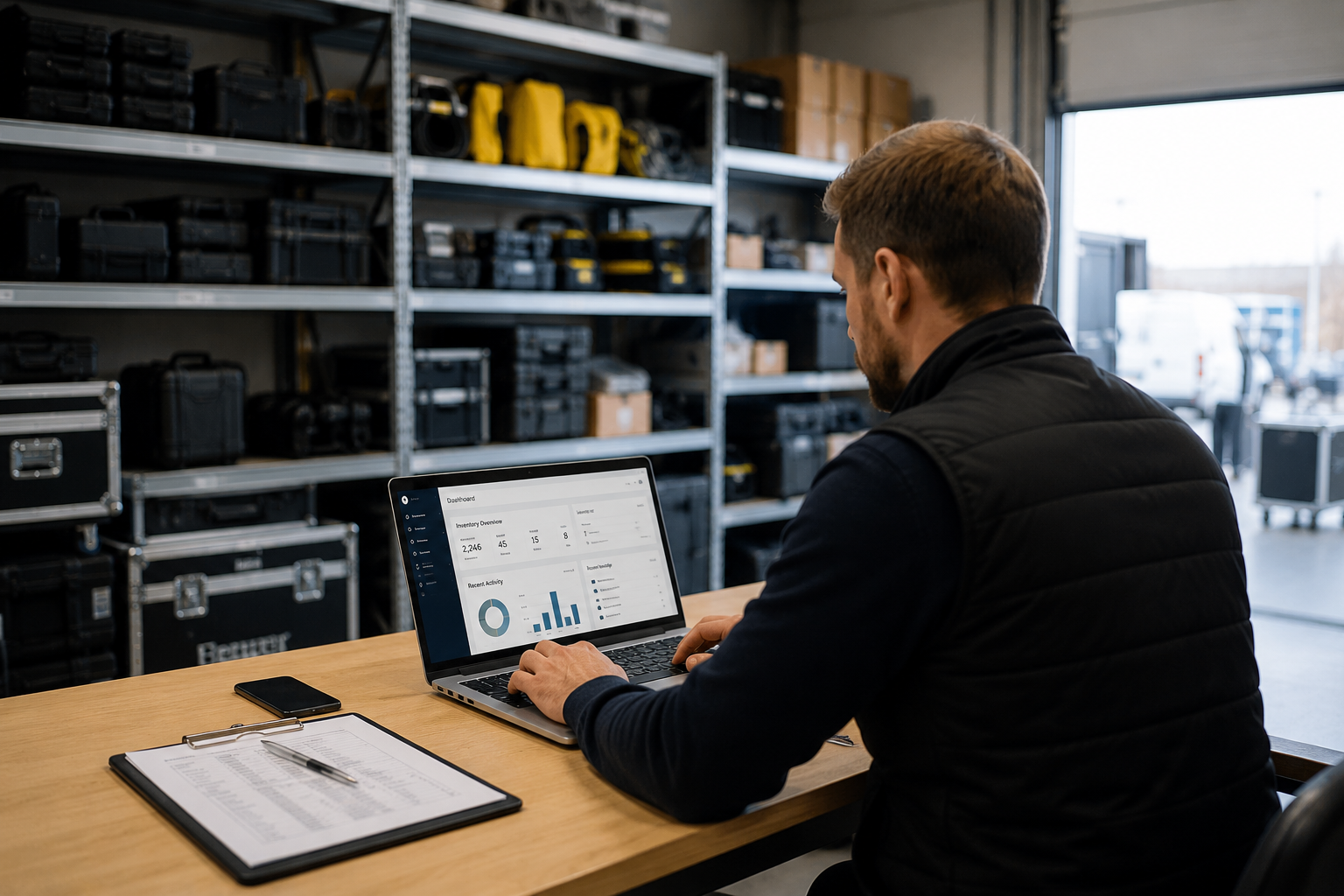
For rental operators, order fulfillment isn’t a single transaction — it’s booking, inventory allocation, and invoicing happening together, often across multiple touchpoints. A unified platform reduces manual administration and the human error that creeps in when these steps live in separate spreadsheets or disconnected tools. Enabling online self-service booking for customers compounds this benefit: fewer manual handoffs means faster turnaround and a better customer experience.
Strategies for Efficient Inflow Inventory
Getting new stock into the system correctly is just as important as tracking it once it’s there. Just-in-time inventory principles and strong supplier relationships help prevent both stockouts and excess inventory tying up capital. A solid inventory and order management workflow records every item the moment it enters the warehouse, which is foundational for accurate equipment rental inventory management and reliable order fulfillment downstream.
Integrating Inventory Software with the Rest of the Business
Inventory software rarely operates in isolation. The strongest platforms offer ecosystem-level integrations — accounting, payments, and ID verification through partners like Nets Easy, plus CRM, access control, and payment systems relevant to self-storage operators. This level of integration is what separates a system that merely tracks stock from one that actually runs the business.
Choosing the Right Inventory Management Tools
What Different Operators Actually Need
The “best” system depends heavily on who’s using it:
- Rental operators moving off spreadsheets want a unified digital solution that increases utilization and revenue per asset — they prioritize reliability and proven, industry-specific automation.
- Mobility managers prioritize customer experience, regulatory compliance, and tools that scale across multiple locations — see vehicle rental fleet management for a deeper look.
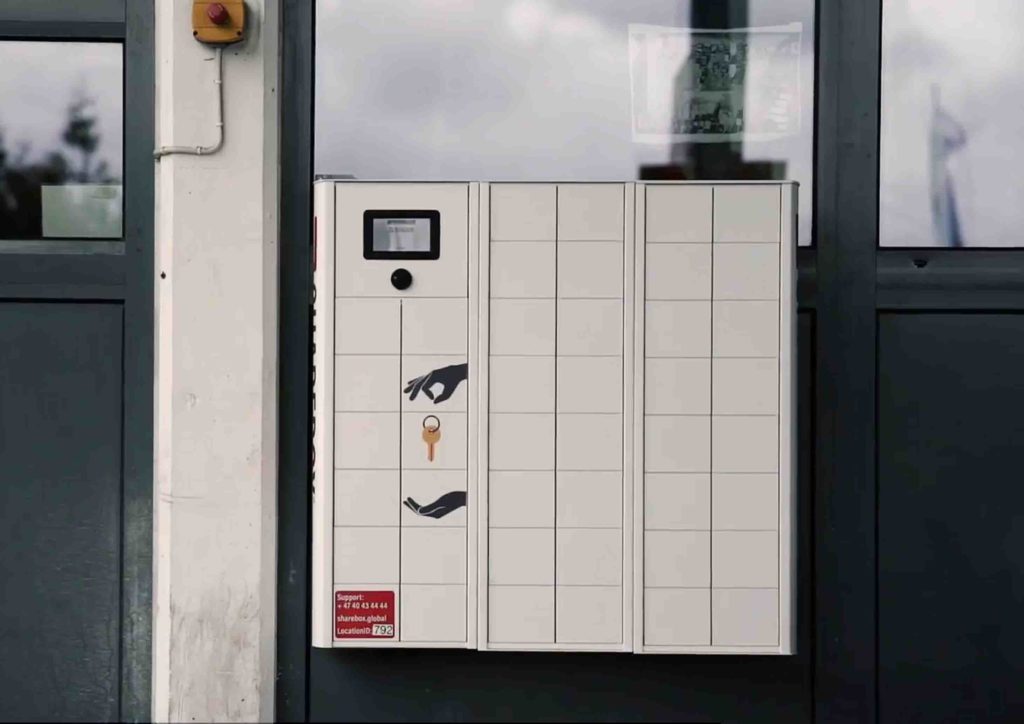
- Self-storage managers focus on automation, 24/7 self-service, and recurring revenue, covered in more depth in self-storage automation.
Free vs. Paid: Making the Right Call
Free tools can handle basic stock tracking for very small operations, but paid solutions unlock multi-location inventory, real-time updates, and genuine order management depth — including warehouse and logistics management for businesses with physical assets moving between sites. The crossover point is usually when manual tracking starts costing more time (and lost utilization) than a subscription would.
Best Practices for Item-Level Management
A few practices consistently separate well-run inventories from chaotic ones:
For rental-specific stock, build in scheduled maintenance checks; see maintenance scheduling for tools and machinery rentals for a practical framework.
Use a barcode or RFID system for every SKU to keep tracking accurate at scale.
Audit inventory levels regularly to catch discrepancies before they compound.
Maintain real-time visibility across the full lifecycle — from purchase order to customer delivery and back — which is the core principle behind any genuinely all-in-one inventory management system.

 All in one platform